
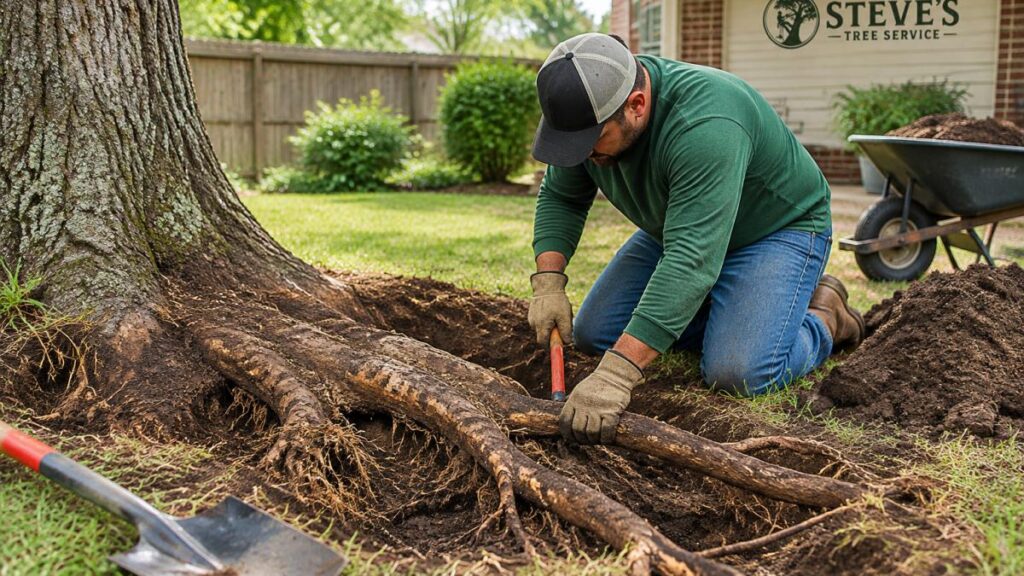
Last Updated: November 19, 2026
Quick Summary
To remove large tree roots from a lawn safely, first check whether the root is structural and call 811 at least two to three business days before digging. Expose the root with a shovel, cut it into sections with a pruning or reciprocating saw, then pry the pieces loose. Call a professional if the root is very thick or the tree leans.
- Call 811 at least two to three business days before you dig.
- Roots wider than about 1 to 2 inches are usually structural and risky to cut.
- Never hand-dig within 18 to 24 inches of a marked utility line.
- Fill the hole in 2- to 3-inch topsoil layers, packing each lightly.
- Keep the top inch of seeded soil moist until the grass is about 2 inches tall.
Table of Contents
- Why Large Tree Roots Cause Lawn Problems
- Check Whether the Root Is Safe to Cut Before You Start
- Tree Root Removal Tools and What Each One Does
- Step-by-Step: How to Remove Large Tree Roots From Lawn Without Damaging the Tree
- Natural Alternatives and Options That Avoid Cutting
- How to Repair Grass After Root Removal
- When to Call a Professional Tree Service
- Frequently Asked Questions
Why Large Tree Roots Cause Lawn Problems
Large tree roots often push up through lawns because they grow wider and closer to the surface over time. Our guide to preventing tree root damage explains how to stop this from happening in the first place.
Roots also compete with grass for water and space. Grass growing over a big root often looks thin, yellow, or patchy.
Before you dig, know what you’re dealing with. The root may be a small feeder root or a large structural root that holds the tree up.
Check Whether the Root Is Safe to Cut Before You Start
Not every root is safe to cut. A root is a lifeline for the tree, and some roots do more than others. Before you start, look at the tree and the root closely, and use the checks below to decide whether the job is a homeowner task or a call to a professional. Our article on tree removal safety protocols every homeowner should know covers the precautions to take before any cutting begins.
How root size and location affect tree stability
Roots fall into two rough groups. Feeder roots are small, thin roots that pull in water and nutrients. Structural roots are large, woody roots that anchor the tree in the ground and hold it upright. Cutting a feeder root usually causes little harm. Cutting a structural root can weaken the tree’s anchor, and a weakened tree can lean or fall, sometimes months after the cut.
Use these rules of thumb to judge the risk:
- Diameter: A root wider than about 1 to 2 inches is usually a structural root. The larger the root, the greater the risk.
- Distance from the trunk: Roots within about 3 to 5 times the trunk diameter are close to the trunk and more likely to be structural. Cutting a root within a few feet of the trunk is high risk.
- Direction: A root running straight out from the trunk on the side the tree leans toward is more likely to be load-bearing.
Watch out: If the root is thicker than your wrist, runs within a few feet of the trunk, or the tree already leans, stop and have a certified arborist assess the tree before you cut anything. An arborist is a tree-care professional trained to judge tree health and stability.
Utility-locating and hand-digging checklist
Before any digging, protect yourself and your property. Buried utility lines can be just inches below the grass, and cutting one is dangerous and expensive to repair.
- Call 811 at least two to three business days before you dig (811 Before You Dig). This is the national call-before-you-dig service. It notifies local utility companies, who mark buried lines for free.
- Wait for the marks. Do not start digging until the utility companies have marked their lines. The marks usually use color-coded paint or flags.
- Keep a safe distance. Hand-dig only with a shovel, never a powered auger or pickaxe, within about 18 to 24 inches of any marked line.
- Dig with care. Use a blunt shovel and small, shallow scoops. If you hit a line, stop and call the utility company.
- Check for private lines. Lines on your side of the meter, such as irrigation, landscape lighting, or a septic line, may not be marked by 811. Locate those yourself or hire a private locator.
Watch out: Never dig near a power line, gas line, or buried utility line, even if you think the root is far from it.
If the tree looks unstable or the root is very large, stop and call a professional.
Tree Root Removal Tools and What Each One Does
Most homeowners use a few basic tools for root work. Each tool has a specific job.
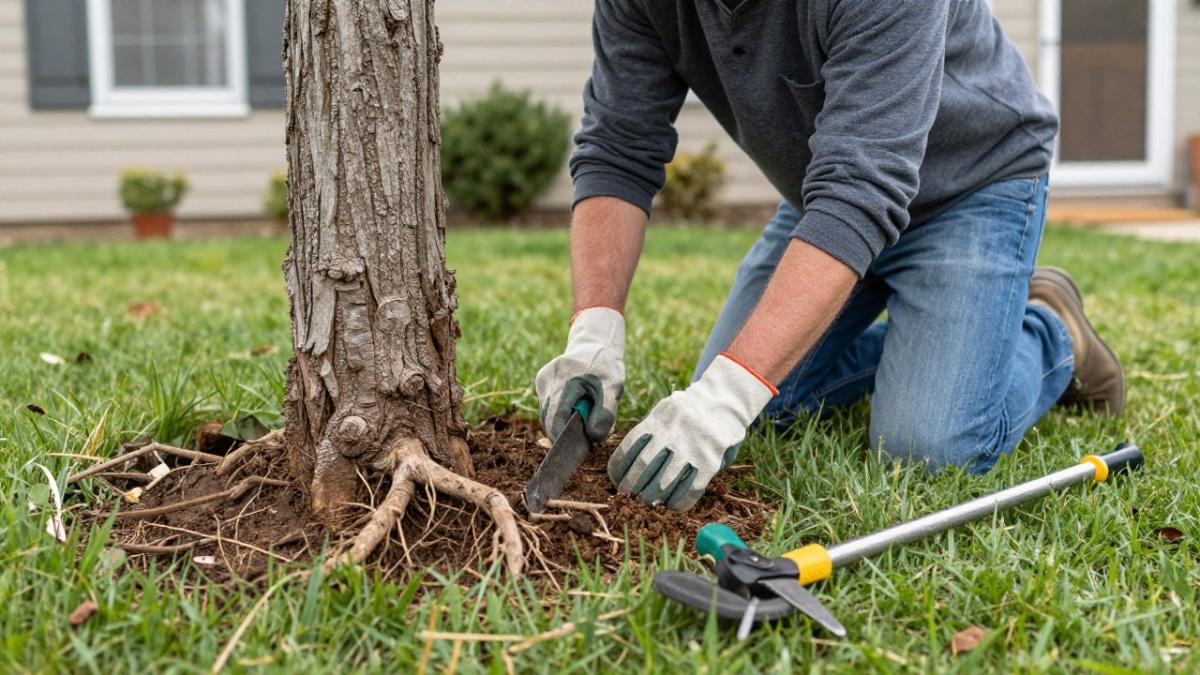
- Pruning saw: Cuts through smaller roots, usually up to a few inches thick.
- Reciprocating saw: Cuts through larger roots, especially if you use a blade made for wood.
- Digging bar: Pries up a root once you’ve loosened the soil around it.
Wear gloves, eye protection, and sturdy boots. A homeowner kneeling beside an exposed root with a pruning saw and digging bar on the grass nearby gives a good picture of the setup.
Most homeowners use a few basic tools for root work, and each one has a specific job.
| Tool | Best for | Key difference |
|---|---|---|
| Pruning saw | Smaller roots | Cuts roots up to a few inches thick |
| Reciprocating saw | Larger roots | Cuts thicker roots, especially with a wood blade |
| Digging bar | Prying up a root | Lifts the root once soil is loosened |
| Mattock or pickaxe | Hard soil near the surface | Breaks up soil and cuts roots near the top |
| Shovel | Clearing loose dirt | Exposes the root so you can see it |
Step-by-Step: How to Remove Large Tree Roots From Lawn Without Damaging the Tree
Follow these steps to remove a root with less risk to the tree and your yard.
- Expose the root. Use a shovel to dig away soil from around the root. Work slowly so you can see where the root goes.
- Check the root again. Make sure it isn’t holding up the tree or running toward utilities.
- Cut the root into sections. Use a pruning saw or reciprocating saw to cut the root into pieces you can handle.
- Pry the sections loose. Use a digging bar to lift each piece out of the ground.
- Clean the cut. Smooth any ragged edges so the tree heals more easily.
- Remove the stump if one remains. A stump may need grinding or removal.
- Fill the hole. Add topsoil and pack it lightly to keep the ground level.
Take your time with each step. Rushing is the most common way to damage a tree.
Natural Alternatives and Options That Avoid Cutting
Cutting is not always the best answer. Some roots can be managed without removal.
- Root barriers can redirect roots that grow toward patios or walkways.
- Raised beds or mulch can cover exposed roots and give grass a better surface.
- Root pruning by a professional trims roots in a controlled way that protects tree health.
Professional trimming can protect the tree while reducing root problems. For tree care that keeps the tree healthy, see our tree trimming services in Weatherford.
How to Repair Grass After Root Removal
After you remove a root, the soil often needs time and care to recover. Grass may thin out where the root was, and the hole left behind can settle if it is not filled correctly. The steps below cover soil depth, grading, seed versus sod, watering, and realistic timelines so the patch blends into the rest of the lawn.
Fill and grade the hole correctly
- Remove loose debris. Pull out root fragments, rocks, and any leftover pieces of the old root so they do not rot or push back up.
- Add topsoil in layers. Fill the hole with topsoil in 2- to 3-inch layers, packing each layer lightly. Do not dump all the soil at once, or the patch will settle later and leave a dip.
- Match the grade. The finished soil should sit level with the surrounding lawn, about 1/4 inch below the grass crowns so the new grass does not sit in a depression. A slight mound is better than a dip, because soil settles over time.
- Let it settle. Water the filled area lightly and wait a few days. Top off any low spots before you seed or sod.
Choose seed or sod
- Seed is less expensive and works well for small patches, but it takes longer to establish and needs consistent moisture. Choose a seed mix suited to your lawn type and the amount of sun the spot gets.
- Sod gives instant cover and is better for larger patches or slopes, but it costs more and needs more water at first. Sod also needs good soil contact, so press it firmly into the topsoil.
A common pattern is to seed small patches and sod anything wider than a few feet, especially on a slope where seed can wash away.
Watering and aftercare
- Seed: Keep the top inch of soil moist but not soggy. Water lightly once or twice a day until the grass is about 2 inches tall, then reduce to deeper, less frequent watering.
- Sod: Water deeply right after installation and then daily for the first week or two, tapering off as the sod knits into the soil.
- Traffic: Keep foot traffic off the patch for several weeks. Mow gently once the new grass is tall enough to cut, and avoid heavy equipment on the repaired area.
Realistic timelines
- Seed: Expect germination in about 7 to 21 days, depending on the grass type and weather. Full coverage usually takes 4 to 8 weeks.
- Sod: Sod knits into the soil in about 2 to 3 weeks and is usually ready for normal use in 4 to 6 weeks.
Watch the patch over the next few weeks. Bare or yellowing areas may need more seed, extra water, or a second pass with topsoil. If the patch keeps sinking, add more topsoil and reseed. For help with tree work that protects the lawn, Weatherford homeowners trust Steve’s Tree Service LLC for safe tree removal, professional tree trimming, and dependable cleanup.
When to Call a Professional Tree Service
Some root jobs are too big or risky for a homeowner to handle alone. Call a professional if the tree leans, the root is very thick, or the root is near power lines or buried utilities.
A professional tree service has the tools and training to cut safely and to judge whether the tree can handle the work. If you’re not sure the job is safe, book professional tree removal in Weatherford or contact Steve’s Tree Service LLC for a free estimate.
Steve’s Tree Service LLC is a Christian-owned company with over 12 years of experience serving Weatherford homeowners. We have 73+ five-star Google reviews. Ask about our free estimates before you start a big job.
Frequently Asked Questions
What kills tree roots without killing grass?
Most people who ask this want to stop a root from growing without harming the lawn around it. Cutting the root is the most direct option, but a large root cut in one spot can still send up new shoots or stress the tree. Targeted root pruning, done by hand with a clean saw cut and limited to roots you have confirmed are safe to cut, is usually the least disruptive method. Avoid broad-spectrum chemical treatments on the soil, because they tend to damage grass and the tree alike. If the root is a serious hazard, a professional can advise on the safest approach for your specific tree.
Can you cut large surface roots without killing a tree?
Sometimes, but not always. Cutting a surface root is less risky than cutting a large structural root, and a tree that is healthy and mature can often tolerate removing a small portion of its root system. The general rule is to avoid cutting more than a small share of the roots on one side of the tree, and to keep cuts clean and close to the root’s natural shape. Cutting roots near the trunk, or several large roots at once, can destabilize the tree and make it more likely to fall in a storm. If you are unsure, have a tree care professional look at it before you cut.
How do I repair a lawn after removing a tree root?
Start by filling the hole with a mix of topsoil and compost, tamping it lightly so it settles level with the surrounding lawn. Keep the soil loose enough for water to reach the roots of new grass. Overseed the bare patch with a grass seed that matches your existing lawn, then water lightly every day until the seedlings are established. Expect the area to look uneven for a few weeks. If the damaged area is large, a sod patch may be a faster fix than seed.
Is it safe to remove roots growing above ground?
Surface roots are generally easier to work with because you can see them and expose them without much digging. Still, check for underground utility lines before you start, and confirm the root is not holding up the trunk or a large limb. Removing a small surface root that is causing a trip hazard is usually manageable for a homeowner. Larger roots, or roots close to the base of the tree, should be evaluated by a professional before you cut them.
