
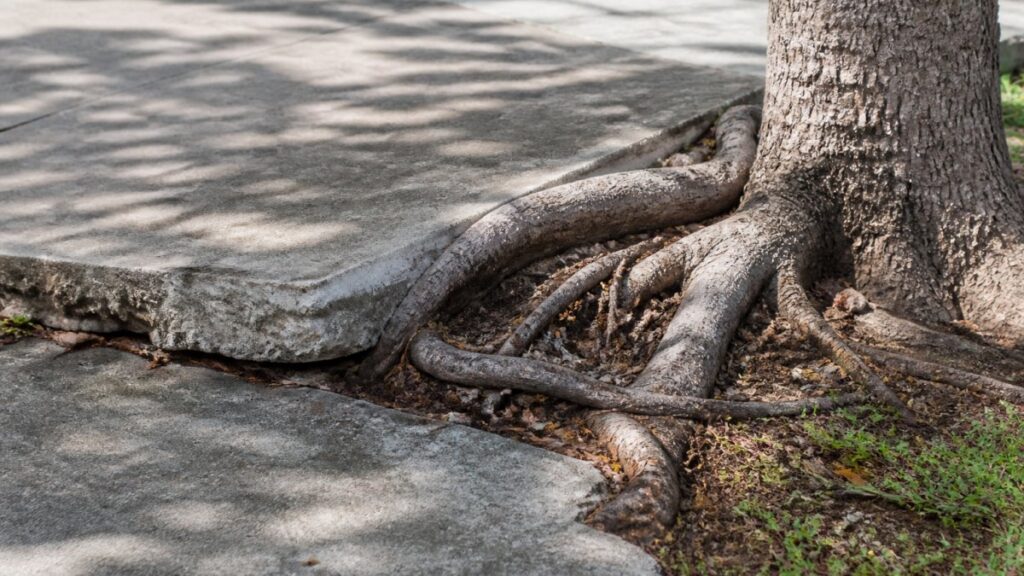
Last Updated: October 23, 2026
Quick Summary
Preventing tree root damage means keeping soil moisture even, planting trees far enough from structures, and installing a root barrier when needed. A barrier should sit about 1 foot from the trunk per inch of trunk diameter and reach 18 to 36 inches deep. Never cut large roots without expert advice.
- Watch for straight cracks in pavement, lifted concrete, soggy spots, and slow drains as early signs of root intrusion.
- Call 811 before digging so underground utilities are flagged, and keep the barrier top 1 to 2 inches above soil grade.
- Water deeply and evenly, fix leaks near the foundation, and avoid planting large trees within 10 to 15 feet of the house.
- Avoid willows, poplars, silver maples, and cottonwoods near structures because they grow fast and root shallow.
- Check the areas around your trees twice a year, ideally in spring and fall, for new cracks, lifting, or surfacing roots.
Table of Contents
- How Tree Roots Cause Damage (and How to Spot It Early)
- Tree Root Barrier Installation: A Step-by-Step Guide
- How to Prevent Tree Roots from Damaging Your Foundation
- Tree Roots Damaging Driveway and Sidewalk: Prevention and Repair
- Tree Roots and Sewer Lines: Protection Strategies
- Choosing Tree Species with Non-Invasive Roots
- When to Cut Roots vs. Remove the Tree: A Decision Guide
- Long-Term Monitoring and Maintenance to Prevent Tree Root Damage
- Frequently Asked Questions
How Tree Roots Cause Damage (and How to Spot It Early)
Tree root damage starts long before you see a crack in the driveway. Roots spread underground searching for water and oxygen, and they push against anything in their path. At Steve’s Tree Service LLC, we’ve spent over 12 years watching how this plays out on properties across Parker County.
Roots rarely break concrete on their own. They exploit weak spots, then expand as they grow. The damage builds slowly, which is why early detection matters so much.
Signs of Root Intrusion Around Your Home
Watch for these warning signs:
- Cracks that run in a straight line across pavement
- Concrete that lifts or tilts near a tree
- Soggy spots in the yard that never dry out
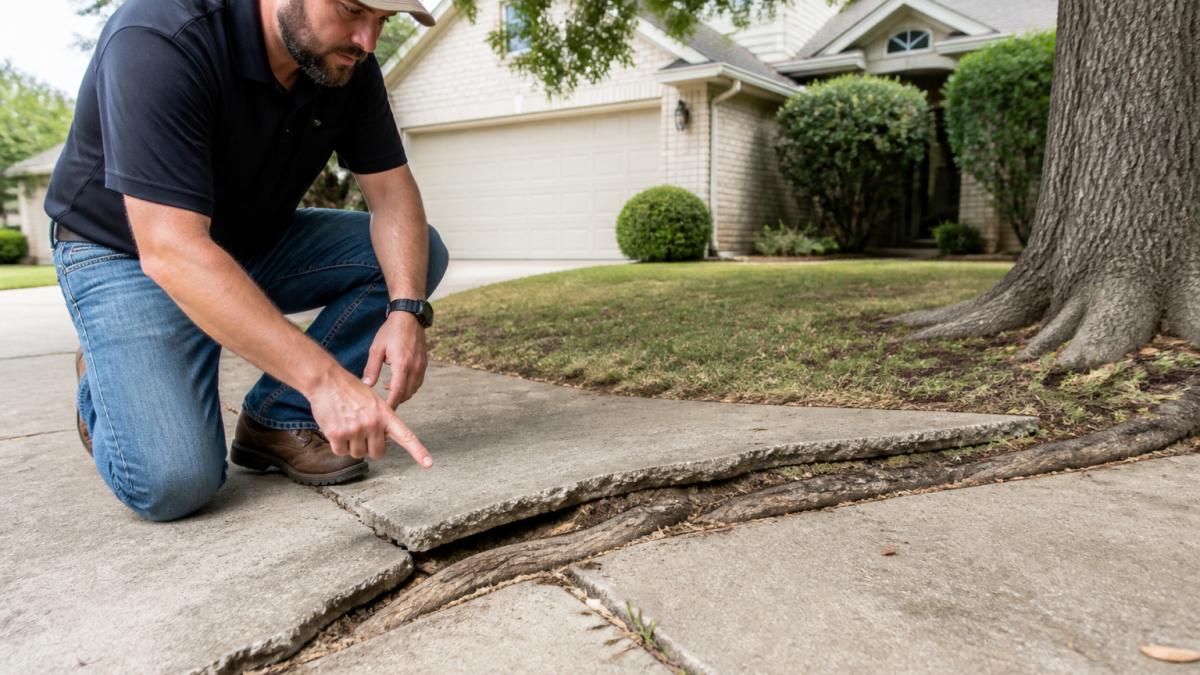
Spotting these early gives you options. Wait too long and the fix gets expensive.
Tree Root Barrier Installation: A Step-by-Step Guide
A root barrier is a physical shield, typically high-density polyethylene (HDPE), fiberglass, or poured concrete, set vertically in the ground between a tree and whatever you want to protect. It does not kill roots or stop the tree from growing; it redirects roots downward and away from the structure. Done right, it buys decades of protection. Done wrong, roots grow under it, over it, or around its ends within a few seasons.
Here is how the work typically goes, with the details that separate a barrier that lasts from one that fails:
- Mark the protection zone and the barrier line. Measure from the structure to where the barrier will sit. Keep the barrier at least as far from the trunk as the tree’s critical root zone allows, a common rule of thumb is 1 foot of barrier distance for every 1 inch of trunk diameter, measured at 4.5 feet above grade (diameter at breast height, or DBH). A 12-inch-DBH tree, for example, should have its barrier no closer than about 12 feet from the trunk.
- Call 811 before you dig. This free service flags underground utilities so you don’t cut a gas, water, electric, or fiber line. Wait for the locate marks and respect the tolerance zone around each flag.
- Trench along the line. Depth matters more than width. Dig a clean, straight channel wide enough to slide panels in without bowing them. Slope the trench bottom so water does not pool against the panels.
- Set the panels. Overlap panels by at least 6 inches and fasten them according to the manufacturer’s instructions. Keep the top edge 1 to 2 inches above finished soil grade so roots cannot creep over the top, a failure point we see often.
- Backfill and water. Tamp soil in 6-inch layers and water each layer to settle it. Backfill with the native soil, not gravel, which can create a drainage channel that pulls roots toward the barrier.
Choosing the Right Barrier Depth and Material
Barrier depth is the detail most homeowners get wrong. Shallow barriers fail because roots simply grow under them. Depth should match the tree’s mature size and root habit, not its current size.
| Material | Best For | Typical Depth | Watch Out For |
|---|---|---|---|
| High-density polyethylene (HDPE) | Most residential projects | 18-24 in | Can bow or crack in rocky or expansive clay soils |
| Fiberglass | Long-term protection, aggressive species | 24-36 in | Higher upfront cost; brittle if mishandled |
| Poured concrete | Heavy-duty situations, utility corridors | 24-36 in | Difficult to install or remove; can crack with soil movement |
For most trees, a barrier should reach 18 to 24 inches deep, though aggressive species, willows, poplars, silver maples, and some elms, may need 30 to 36 inches.
Site Factors That Decide Whether a Barrier Works
- Soil type. In sandy soils, roots push deeper and barriers need to go deeper. In expansive clay, panels can bow; use thicker HDPE or fiberglass. In rocky soil, trenching may require a trencher rather than hand tools.
- Drainage. A barrier can act as a dam. If the trench crosses a drainage path, install it so water still moves away from the foundation, or add a French drain alongside.
- Root flare. Never bury the root flare (the widening where trunk meets roots). Keep the barrier far enough out that backfill does not smother it.
Set the barrier top about an inch above the soil line. This stops roots from creeping over the top, a failure point we see often.
A barrier is not a substitute for proper planting distance. If a tree is already too close to a foundation, a barrier can slow damage but will not eliminate it. Have an arborist assess the tree before you dig.
Barrier success comes down to three numbers: distance from the trunk (about 1 foot per inch of DBH), depth (18-36 inches depending on species), and top height (1-2 inches above grade). Get those right and the barrier does its job.
How to Prevent Tree Roots from Damaging Your Foundation
Keeping soil moisture steady is your best defense against foundation damage. Roots chase water, so a yard that dries out in one spot and stays wet in another pulls roots toward your house.
Follow these habits:
- Water deeply and evenly across the root zone
- Fix leaky spouts and poor drainage near the foundation
- Keep mulch a few feet back from the foundation wall
Soil compaction is another quiet culprit. Heavy foot traffic and parked cars squeeze the air out of soil, which stresses roots and pushes them toward foundations. Keep the root zone soft and covered.
Tree Roots Damaging Driveway and Sidewalk: Prevention and Repair
Pavement lifting is the most common complaint we hear. Roots swell under slabs and push them up, creating trip hazards and cracked concrete.
Prevention beats repair every time. When planting, give trees enough room from hardscape. A large shade tree needs at least 10 feet of clearance from a driveway or patio.
If roots are already causing trouble, you have a few options:
- Grind down the lifted edge to remove the trip hazard
- Reroute the walkway around the root zone
- Install a barrier to stop further spread
Cutting a large root to save a sidewalk can weaken the tree and make it a fall risk. Never cut a root thicker than a few inches without expert advice.
Tree Roots and Sewer Lines: Protection Strategies
Sewer lines attract roots because they carry water and nutrients. Older clay or cast-iron pipes with small cracks are the easiest targets.
Here is how to protect them:
- Have your sewer line inspected if you notice slow drains
- Repair cracked pipes promptly
- Keep trees with aggressive roots well away from the line
If roots have already found their way in, a plumber can clear them, but the tree will keep coming back until the pipe is sealed or the tree is managed.
Choosing Tree Species with Non-Invasive Roots
Species selection is the smartest long-term move for preventing tree root damage. Some trees have deep, slow-spreading roots. Others send shallow roots far and wide. The difference is not random, it tracks mature size, root habit, and how the species responds to soil moisture.
Trees with less aggressive root systems generally include:
- Most oaks (white, bur, and swamp white), which root deeply and grow slowly relative to their spread
- Hickory and walnut, which develop deep taproots and are less likely to lift pavement
- Certain maples (sugar and Japanese maple), depending on variety and site
Avoid willows, poplars, silver maples, and cottonwoods near structures. These grow fast and root shallow, making them more likely to lift pavement and find pipes.
Matching Mature Size to Planting Distance
A practical rule of thumb: plant a tree at least as far from a structure as half its mature canopy spread, and never closer than 10 feet for a small ornamental or 20 feet for a large shade tree. The table below connects mature size, root behavior, and a safe minimum distance from foundations and hardscape.
| Mature Size | Example Species | Root Behavior | Minimum Distance from Structure |
|---|---|---|---|
| Small (under 25 ft) | Japanese maple, serviceberry | Shallow but contained | 8-10 ft |
| Medium (25-50 ft) | Ginkgo, hornbeam, sugar maple | Moderate spread | 15-20 ft |
| Large (over 50 ft) | White oak, hickory, walnut | Deep, wide spread | 20-30 ft |
| Aggressive/fast | Willow, poplar, silver maple | Shallow, far-reaching | 30+ ft, or avoid near structures |
These are starting points, not absolutes. Soil type, irrigation, and drought stress all shift how far roots travel. In sandy or well-drained soils, roots often go deeper; in compacted or clay soils, they stay shallow and spread wider.
Site-Specific Factors That Change the Answer
- Soil moisture. Roots chase water. A tree planted near a regularly irrigated lawn will root more shallowly and widely than the same species on a dry site.
- Drought and irrigation. Alternating wet and dry cycles pull roots toward foundations and pipes. Steady, even moisture keeps roots more balanced.
- Local regulations. Some municipalities maintain approved tree lists or restrictions for planting near right-of-way and utilities. Check before you plant.
Match the tree to the space, not the other way around. A tree that fits its mature size will cause far fewer problems than one planted too close to a house, and no barrier or pruning schedule fully compensates for a species planted in the wrong spot.
When to Cut Roots vs. Remove the Tree: A Decision Guide
This is the call homeowners dread, and it deserves a clear framework. Use this decision guide:
- Cut roots only when the root is small, the tree is healthy, and the cut is clean and limited.
- Remove the tree when roots are severely damaging a foundation, the tree leans, or it has become unstable.
- Repair the structure when the damage is minor and the tree can be redirected with a barrier.
Root pruning is not a casual fix. Cutting too many roots at once can kill a tree or make it topple. As a rule, never remove more than a small share of the root system in one go, and only make clean cuts with a proper pruning saw.
The safest path is often a barrier plus monitoring. It protects the structure without gambling on the tree’s stability.
Long-Term Monitoring and Maintenance to Prevent Tree Root Damage
Preventing tree root damage is a habit, not a one-time job. Check the areas around your trees twice a year, ideally in spring and fall.
Look for:
- New cracks or lifting in pavement
- Changes in drainage or soggy patches
- Roots surfacing near foundations
Keep grass competition in check and maintain a healthy mulch ring. Healthy trees grow steadier roots and cause fewer surprises.
At Steve’s Tree Service LLC, we offer free estimates and honest guidance on whether a tree can stay or needs to go.
Frequently Asked Questions
How can I prevent tree roots from damaging my foundation?
Keep trees at least 10 to 20 feet from your foundation, depending on mature size. Install a root barrier 3 to 4 feet deep between the tree and the house. Manage soil moisture with consistent irrigation to discourage roots from seeking water under the slab. Monitor for cracks and call an arborist if you see new gaps. Steve’s Tree Service LLC offers free estimates to assess your risk and recommend barriers or pruning.
Should I cut tree roots that are damaging my property?
Cutting roots can destabilize the tree and cause decline. Never remove more than 20 to 25 percent of the root zone in one season. Make clean cuts with a pruning saw and avoid tearing. For roots larger than 2 inches in diameter, consult an arborist first. If the tree is hazardous, removal may be safer. Steve’s Tree Service LLC has over 12 years of experience evaluating root damage and tree stability in Parker County.
How do I stop tree roots from damaging a driveway or sidewalk?
Install a root barrier along the pavement edge, at least 3 feet deep. Choose species with non-aggressive roots for new plantings. For existing trees, root pruning may help but must be done carefully. Avoid compacting soil over the root zone. If pavement is already lifted, a contractor can repair it. Steve’s Tree Service LLC provides trimming to protect hardscapes.
Can a root barrier prevent tree roots from spreading?
Yes, a properly installed root barrier redirects roots downward and away from structures. Install it 3 to 4 feet deep and extend it 2 feet beyond the drip line. Materials include high-density polyethylene and concrete. Barriers require professional installation to avoid tree damage.
Tree roots are patient. They work quietly until the damage shows up on your driveway or in your basement. Don’t wait for that crack to widen. Steve’s Tree Service LLC brings over 12 years of experience, free estimates, and a commitment to leaving your property clean and safe. We’re Christian-owned, and we treat every home like our own. Get a quote today and protect your property before roots get the upper hand.
