
Last Updated: November 8, 2026
Quick Summary
Tree removal safety starts with a tree risk assessment that weighs failure likelihood, likelihood of impact, and consequences of failure before any cut is made. Walk the target zone first, then inspect the crown, trunk, and root plate for defects, and call a certified arborist when a trunk, root, or lean problem puts a structure at risk.
- Tree risk assessment combines failure likelihood, likelihood of impact, and consequences of failure into one rating.
- Inspect in a fixed order: target zone, crown, trunk, roots and root plate, site and weather, then work area.
- Professionals wear hard hats, eye and hearing protection, cut-resistant chaps, steel-toe boots, and climbing harnesses.
- After a storm, assume any downed wire is live and call the utility company before approaching.
- Stop and call a qualified arborist if a cavity, crack, or split appears in the main trunk.
Table of Contents
- Why Tree Removal Safety Protocols Matter for Your Home
- Tree Risk Assessment: The First Step Before Any Cut
- Hazardous Tree Warning Signs You Can Spot Yourself
- Your Tree Removal Safety Checklist for Homeowners
- Tree Removal Personal Protective Equipment: What Pros Wear and Why
- Storm Damage and Emergency Tree Removal Safety
- When to Stop Inspecting and Call a Qualified Arborist
- Get a Free Estimate from Steve’s Tree Service LLC
- Frequently Asked Questions
Why Tree Removal Safety Protocols Matter for Your Home
A dead limb hanging over a roof does not care how careful you are with a ladder.
A tree risk assessment is a structured way to judge whether a tree, or part of one, is likely to fail and what it would hit if it did. That single idea drives every protocol below.
Here is what we cover: how to read a tree for danger, what protective gear professionals wear and why, what to do after a storm, and the exact point where you should stop and call a certified arborist.
Tree Risk Assessment: The First Step Before Any Cut
Tree risk assessment is the process of combining three things: how likely a tree is to fail, what it could hit, and how bad the outcome would be. Professionals call these failure likelihood, likelihood of impact, and consequences of failure.
The Three Components of Tree Risk Assessment
- Failure likelihood: how probable is it that the whole tree, or a branch, trunk, or root plate gives way?
- Likelihood of impact: is there a target below? A house, a car, a shed, a fence, or people?
- Consequences of failure: what gets damaged, and how serious is it?
A tree leaning over an empty back field is a low-risk situation. The same tree leaning over a bedroom is a different conversation entirely. Same tree, same defect, very different risk rating.
A free estimate is a good place to start, and it begins with an assessment of the site.
Hazardous Tree Warning Signs You Can Spot Yourself
You do not need a license to notice that something looks wrong. Walk your property after any big wind and check for these hazardous tree warning signs:
- Dead branches with no leaves in season, brittle and snapping easily
- Hanging branches still attached but broken
- Cracks in the trunk or where a branch meets it
One sign alone is not always an emergency. For a deeper walkthrough of each indicator, read our guide to the signs a tree is hazardous. If you suspect the tree is already dead, our article on identifying dead trees near your house covers what to look for before they fall.
Your Tree Removal Safety Checklist for Homeowners
This tree removal safety checklist is a step-by-step inspection you can do on foot, with both feet on the ground, before anyone arrives. It does not cover cutting. It covers reading the tree from the top down and the ground up, in a fixed order, so you do not miss the defect that matters.
Step 1: Set Up Your Walk Path
Before you look at the tree, look at what is under it. Walk the target zone, the area the tree or its limbs would hit if they fell. Note the house, garage, shed, fence, driveway, parked cars, power lines, and any spot where people sit, play, or walk. A tree with a defect over an empty field is a different situation than the same defect over a bedroom.
Step 2: Inspect the Crown (the Top of the Tree)
Stand back far enough to see the whole canopy. Look for:
- Deadwood, branches with no leaves in season, brittle and snapping easily
- Hangers, broken limbs still attached and hanging in the canopy
- Cracks where a branch meets the trunk (the branch collar)
Step 3: Inspect the Trunk
Walk around the full circumference. Look for:
- Cracks or splits in the bark and wood
- Cavities, hollow spots or soft, punky wood you can push a tool into
- Fungal growth such as mushrooms or conks on the trunk
Step 4: Inspect the Roots and Root Plate
The root plate is the shallow, wide mass of roots that anchors the tree. Look for:
- Soil heaving, ground pushed up on one side of the base
- Exposed roots on one side
- A new lean that was not there before
Step 5: Check the Site and Weather Factors
Tree condition is only part of the picture. Note recent construction, grading, or paving near the roots, which can cut roots and destabilize the tree. Note whether the soil stays wet, which weakens anchorage. Note whether the tree is a species prone to weak wood or shallow roots. And note the season, a tree in full leaf catches more wind than a bare one.
Step 6: Prepare the Work Area Before the Crew Arrives
Once you have inspected, clear what you can control:
- Move cars, trailers, and lawn equipment away from the drop zone
- Take down bird feeders, wind chimes, and hanging planters
- Clear patio furniture and grills from under the canopy
Watch out: never stand under a tree while someone is cutting, even to “just watch.” Wood falls faster than you can move, and a limb that looks small on the ground can weigh more than you think. If any step above turns up a defect you cannot explain, stop and move to the next section, that is your signal to call a professional.
Here is the inspection sequence to follow, in order, with both feet on the ground.
| Step | What to inspect | What to look for |
|---|---|---|
| Step 1 | Target zone | House, garage, fence, cars, power lines, people |
| Step 2 | Crown | Deadwood, hangers, cracks at branch collar |
| Step 3 | Trunk | Cracks, cavities, fungal growth, seams, frass |
| Step 4 | Roots and root plate | Soil heaving, exposed roots, new lean, soil cracks |
| Step 5 | Site and weather | Construction, wet soil, species, season |
| Step 6 | Work area | Move cars, clear furniture, keep kids and pets inside |
Tree Removal Personal Protective Equipment: What Pros Wear and Why
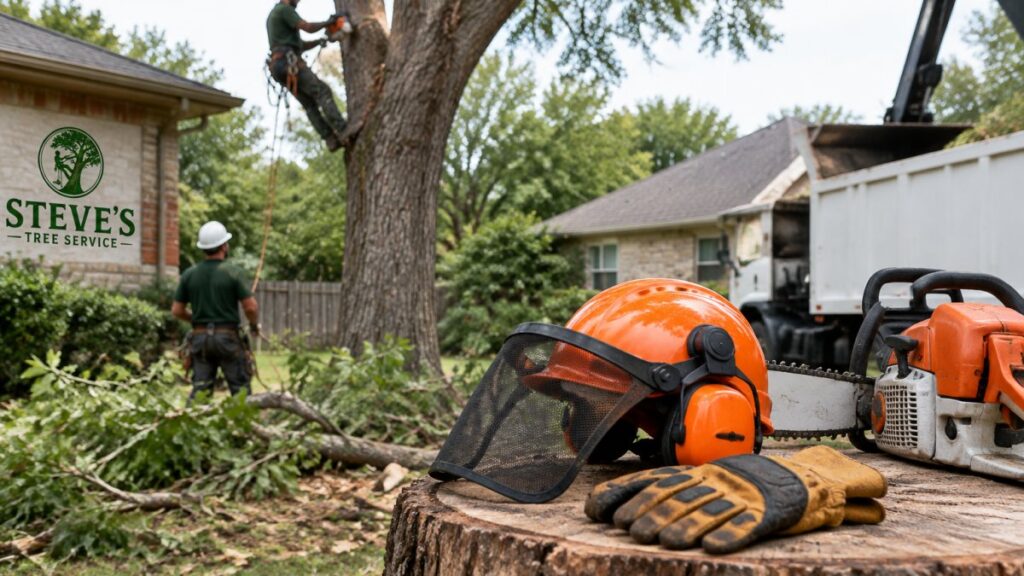
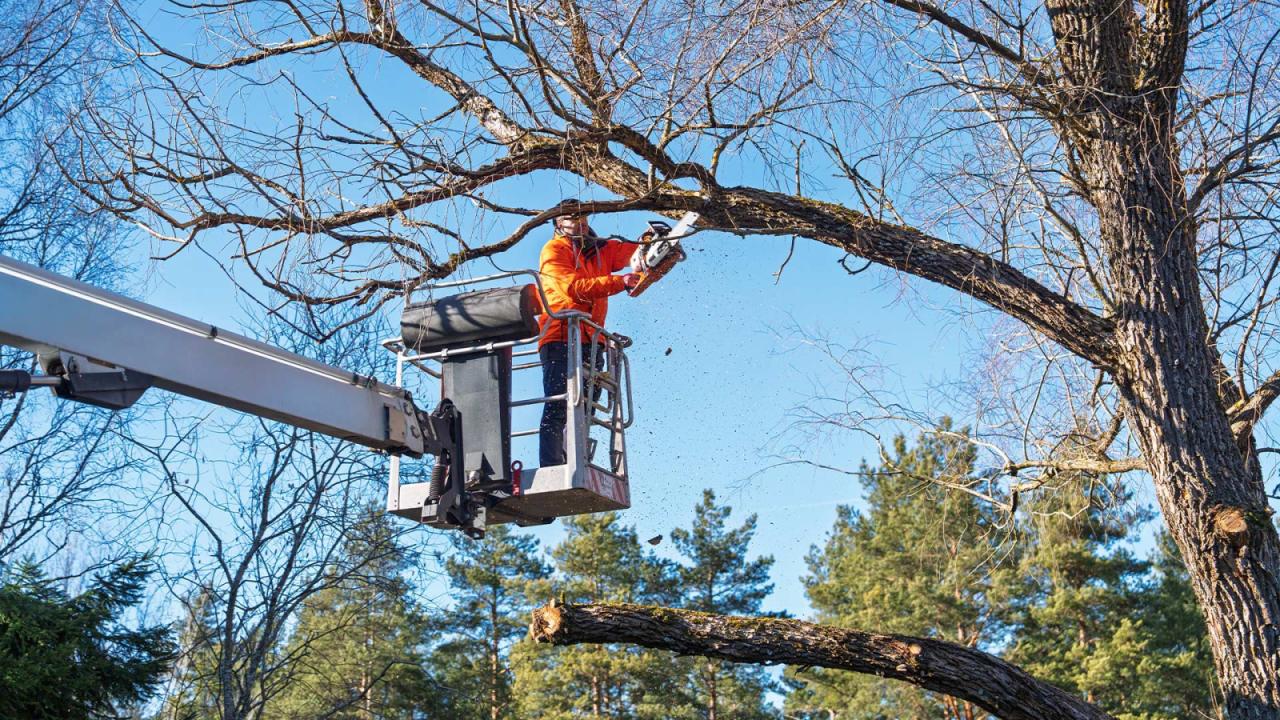
Tree removal personal protective equipment is not decoration. Each piece exists because someone got hurt without it. Here is what a professional wears and the reason behind it.
- Hard hat: protects against falling limbs and head knocks in the canopy
- Safety glasses or face shield: stops sawdust, chips, and twigs from hitting eyes
- Hearing protection: chainsaws run loud enough to damage hearing over time
If you hire someone who shows up in sneakers and shorts, that tells you something. Professional crews generally gear up before the first cut.
Storm Damage and Emergency Tree Removal Safety
After a storm, the most dangerous trees are the ones still standing. A cracked trunk or a limb hung up in another tree can drop hours or days later with no warning.
Follow these steps right after a storm:
- Stay back from downed lines. Assume any wire on the ground is live and call the utility company.
- Do not walk under leaning or hung-up trees. They can shift without notice.
- Photograph the damage for insurance before anything is moved.
- Keep the area clear and wait for a professional assessment.
- Call for help if a tree is on a structure or blocking access.
If you are facing this right now, our guide on emergency tree removal walks through exactly what to do next, step by step. Weatherford homeowners can call Steve’s Tree Service LLC for emergency tree service and storm cleanup.
When to Stop Inspecting and Call a Qualified Arborist
A visual inspection is a snapshot, not a verdict. You can notice a defect, but you cannot rate how likely it is to fail or how much force it would carry when it does. That is the line between what you can observe and what a qualified arborist, a tree professional trained to assess risk, needs to judge.
The Stop-Inspecting Decision Guide
Use this sequence to decide whether to keep watching or call now.
Stop and call now if any of these are true:
- The tree leans toward your house, a driveway, or a power line
- There is a cavity, crack, or split in the main trunk
- The base is heaving or roots are exposed on one side
Monitor and reassess if all of these are true:
- The defect is small and on a limb, not the trunk
- The tree is far enough from targets that a fall would hit open ground
- You can see the whole tree clearly and the defect is not changing
What a Qualified Arborist Actually Does
An arborist rates failure likelihood, how probable it is that the tree or a part of it gives way, and combines that with the likelihood of impact and the consequences of failure. Those three together produce a risk rating. A certified arborist has passed a credential exam. Ask for the credential and proof of insurance before you hire.
Mitigation Options and Trade-Offs
Risk can be managed in more than one way. A common pattern is:
- Pruning, removes the defective limb and reduces weight and wind catch; appropriate when the defect is limited to a branch
- Target management, moves people, cars, or structures out of the fall zone; appropriate when the tree is sound but the target is the problem
- Monitoring, reassess on a set schedule; appropriate for a small defect far from targets
Document Changes Over Time
Take dated photos of the defect from the same angle each season. A crack that looks the same in March and September is behaving differently from one that has widened. Bring those photos to your arborist visit, they turn a single snapshot into a record.
If a tree is threatening your home right now, do not wait it out. You can request emergency tree service and get a crew out to assess it safely.
Get a Free Estimate from Steve’s Tree Service LLC
Every property is different, and so is every tree.
Steve’s Tree Service LLC has served Weatherford and Parker County for over 12 years.
When you are ready to move forward, you can schedule your tree removal and get a clear plan for the safest way to handle your tree.
Tree removal safety protocols are not red tape. They are the difference between a clean job and a trip to the emergency room.
Frequently Asked Questions
What is the 10/20/30 rule for trees?
The 10/20/30 rule is a simple way to remember safe limb clearance around your home. Keep limbs at least 10 feet away from power lines, 20 feet from the roof, and 30 feet from the ground. These distances help prevent branches from contacting electrical wires or damaging shingles during storms. If your trees are closer than these guidelines, a professional can trim them safely.
What are the three components of tree risk assessment?
A tree risk assessment looks at three things: the likelihood of failure, the likelihood of impact, and the consequences. First, an arborist checks for structural defects that could cause a tree or branch to fall. Next, they note what is beneath the tree, such as a house, car, or patio. Finally, they weigh how serious the damage would be if failure occurred. Together these factors produce a risk rating.
What safety precautions should be taken when removing a tree?
A safe tree removal starts with a tree removal safety checklist: clear the work zone, identify power lines, and plan escape routes. Crews wear tree removal personal protective equipment, including hard hats, eye protection, and chainsaw chaps. They use ropes and rigging to control how branches fall. Homeowners should keep children and pets inside and never stand under the tree while work is underway.
How quickly can Steve’s Tree Service LLC respond to storm damage?
Steve’s Tree Service LLC offers emergency tree service and storm cleanup for Weatherford and Parker County homeowners. Response times depend on storm severity and call volume. Call as soon as it is safe to do so, and stay away from downed power lines until utility crews arrive.
