
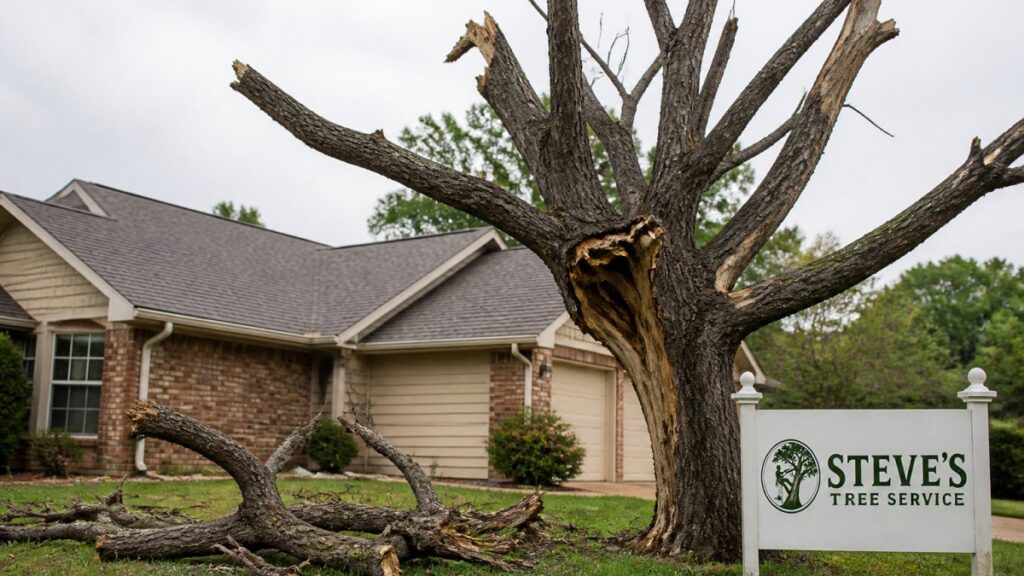
Last Updated: October 30, 2026
Quick Summary
Identifying dead trees near your house starts with a slow walk around the property from a safe distance of at least one and a half times the tree’s height. Check the canopy for bare sections, the trunk for cracks and missing bark, and the base for mushrooms or soil cracks. Confirm with the twig test: a dead twig snaps dry and brown, while a living one bends and is green inside.
- Do a walk-around two or three times a year and again after any big storm.
- A tree that is bare in July is a very different concern than one bare in January.
- A dead tree can drop branches on a calm day with no wind at all.
- If any part of the tree nears power lines, call your utility company first.
- Do not cut a hanging limb yourself, since a limb under tension can kick back.
Table of Contents
- Start with a Safe Walk-Around: Your Homeowner Inspection Checklist
- Signs of a Dead Tree: What to Look For on Trunk, Branches, and Canopy
- How to Tell If a Tree Is Dead or Dormant: Seasonal Look-Alikes
- Dead Tree Near House Danger: Understanding Fall Risk and Targets
- When to Remove a Dead Tree: Timing Your Decision
- What to Do Immediately If a Tree May Be Hazardous
- How to Choose a Qualified Tree Professional
- Get a Free Estimate from Steve’s Tree Service LLC
- Frequently Asked Questions
Start with a Safe Walk-Around: Your Homeowner Inspection Checklist
Identifying dead trees near your house starts with a slow walk around the property to spot dead trees. A tree that looks dead in January may be perfectly alive.
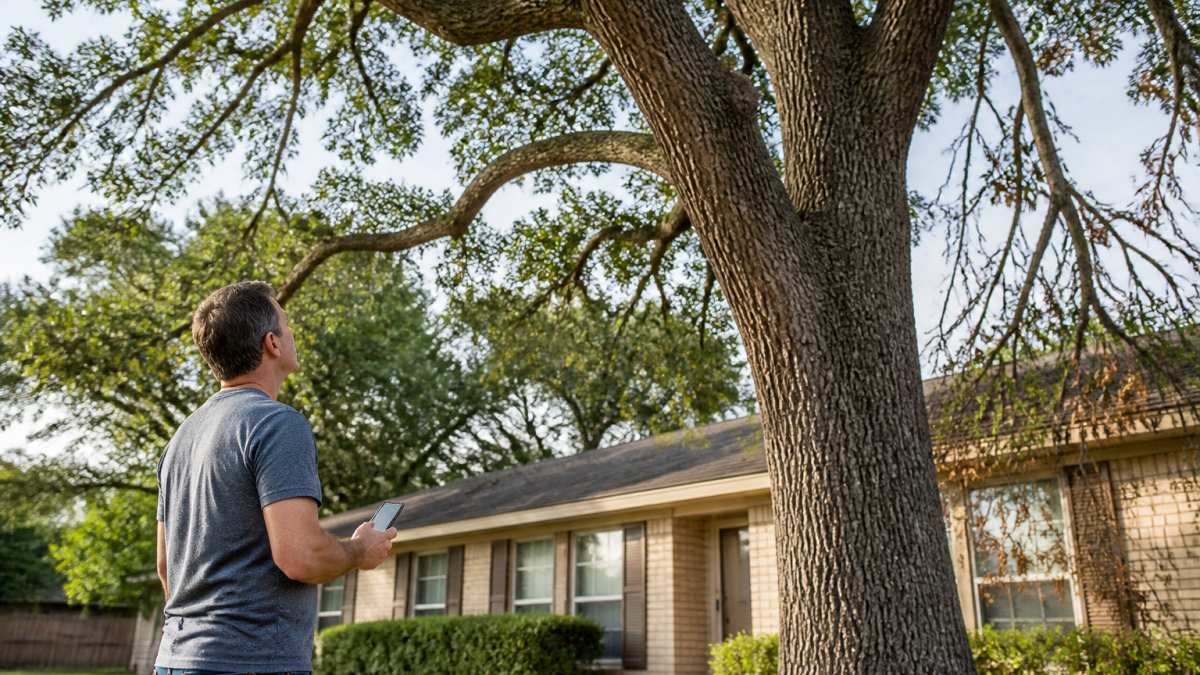
Do this walk two or three times a year, and again after any big storm. The goal is not to diagnose the tree yourself, it is to notice changes early and know when to call a professional.
Step 1: Set Up a Safe Viewing Distance
Before you look at any tree, pick a spot at least one and a half times the tree’s height away from the trunk. This keeps you out of the fall zone, the area a tree or limb would hit if it came down. If the tree leans toward your house, stand off to the side.
Step 2: Scan the Whole Canopy from Afar
Look up at the entire leafy top, called the canopy, from your safe distance. You are checking for:
- Large bare sections that stay empty in spring and summer
- Deadwood that looks gray or rattles in the wind
- Branches hanging lower than usual or pointing in odd directions
Use your phone’s camera zoom to get a closer look without moving closer. A photo also gives you a baseline to compare next season.
Step 3: Walk the Trunk on All Sides
From your safe distance, circle the tree slowly and check the trunk from the base to the first big branches. Look for cracks, holes, missing bark, and peeling bark. Note any cavities, hollow spots or openings, especially large ones. Do not stick your hand or a tool into a hole; you can disturb nesting animals or a wasp nest.
Step 4: Check the Base and Root Flare
The root flare is where the trunk widens into the roots. Look for mushrooms, shelf-shaped fungal growths, soft or sunken soil, and fresh soil cracks. A new lean with soil pushed up on one side often means the root plate is shifting, a serious warning sign.
Step 5: Note Anything Overhead
Look for dead branches hanging over the roof, driveway, sidewalk, or power lines. These are the limbs most likely to cause damage. If any part of the tree touches or nears a power line, stop and call your utility company. Never touch a limb near a wire.
Step 6: Document and Compare
Photograph anything that worries you from a safe distance. Note the date and what you saw. Comparing photos season to season is one of the most reliable ways to tell whether a tree is declining or just dormant.
Keep your feet on the ground the whole time. A pair of binoculars or a phone with zoom is safer and more useful than getting closer.
If anything on this walk makes you uneasy, call a professional for an assessment. Steve’s Tree Service LLC offers free estimates.
Signs of a Dead Tree: What to Look For on Trunk, Branches, and Canopy
A dead tree shows itself in three places: the branches, the trunk, and the base. The canopy is the leafy top of the tree. When the canopy thins out and does not fill back in, that is your first clue.
Brittle, Bare, or Missing Branches
Pick a small twig from a low branch and bend it. A healthy tree twig bends and feels springy inside, often green under the bark.
Other branch signs:
- Bare branches that stay empty through spring and summer
- Deadwood that rattles or looks gray against live wood
- Branch dieback starting at the tips and working inward
That last one matters. Dead branches concentrated on one side often point to root damage on that side, and root damage is the hardest problem to fix.
Trunk Cracks, Cavities, and Missing Bark
The trunk is the tree’s spine. Run your eyes from the base to the first big branches and look for:
- Cracks running up or down the bark
- Cavities or hollow spots you could poke a finger into
- Missing bark in patches, especially on one side
Watch out: a cavity can look small on the outside while the inside is mostly hollow. Do not stick your hand or a tool into a hole in a tree. You can disturb nesting animals or a wasp nest.
Fungal Growth, Mushrooms, and Pest Activity
Fungal growth at the base of a tree is a serious signal. Mushrooms and shelf-shaped fungal spore structures growing out of the trunk or roots mean the wood inside is breaking down. Wood decay is happening where you cannot see it.
One mushroom does not condemn a tree. A ring of them around the base, combined with a thinning canopy, is a different conversation.
How to Tell If a Tree Is Dead or Dormant: Seasonal Look-Alikes
How to tell if a tree is dead or dormant comes down to timing and testing. Dormancy is a tree’s winter rest, when it drops leaves and slows down on purpose.
Here is how the two compare:
| Feature | Dormant Tree | Dead Tree |
|---|---|---|
| Twig bend test | Bends, green inside | Snaps, brown inside |
| Buds | Plump buds on twigs | No buds, or dry, shriveled buds |
| Bark | Tight and attached | Peeling or falling off |
| Base of tree | Firm soil, no growths | Mushrooms, soft soil |
| Next spring | Leafs out on schedule | Stays bare |
The twig test is the fastest check. Scratch a small branch with your thumbnail. Green and damp means alive. Brown and dry means dead.
Timing matters too. Do your checks in late spring or early summer, when a living tree should be fully leafed out.
Dead Tree Near House Danger: Understanding Fall Risk and Targets
A dead tree near house danger is not about the tree’s size. It is about what sits underneath it. Arborists call that the target: the person, roof, car, fence, or power line a falling tree would hit.
Get a Free Tree Service Estimate →
What Makes a Tree a Safety Hazard?
A tree becomes a safety hazard when two things line up: the tree is likely to fail, and something valuable sits in the fall zone. For a closer look at the warning signs, see signs a tree is hazardous. A dead tree in an open field is low risk. The same tree leaning over a bedroom is a serious problem.
Risk factors that raise the odds of tree failure:
Leaning Trees, Root Damage, and House Proximity
A tree that has always leaned a little is usually fine. A tree that started leaning last month is not.
Watch out: do not try to prop, cable, or brace a leaning dead tree yourself.
Falling limbs are the other risk. A dead tree can drop branches on a calm day with no wind at all.
When to Remove a Dead Tree: Timing Your Decision
Remove a dead tree when it is confirmed dead and it sits within reach of something you care about. Waiting rarely makes it safer. Arborists think about risk in two parts: the likelihood of failure (how likely the tree is to come down) and the target (what it would hit).
How to Think About Failure Likelihood
Failure likelihood goes up when you see:
- A leaning tree with fresh soil cracks at the base
- Root damage from construction, trenching, or grade changes
- Trunk damage with deep cracks or hollow sections
A tree that has always leaned a little is usually fine. A tree that started leaning last month is not. Look for soil pushed up on one side of the base, or a gap opening on the other. That is the root plate shifting.
How to Think About the Target
The target is whatever sits in the fall zone: your roof, a bedroom window, a driveway, a sidewalk, a fence, a car, or a power line. A dead tree in an open field is low risk. The same tree leaning over a bedroom is a serious problem. Occupancy matters too, a tree over a shed you rarely use is less urgent than one over a child’s bedroom.
A Simple Urgency Guide
Use this guide to decide how quickly to act:
| Situation | Urgency |
|---|---|
| Dead tree leaning toward a house, with fresh soil cracks at the base | Act now, keep people away and call a professional today |
| Large dead limbs hanging over a roof, driveway, or walkway | Act now, treat as an emergency |
| Tree touching or near power lines | Call your utility company first, then a professional |
| Dead tree within falling distance of a house but no lean or fresh defects | Schedule an assessment soon |
| Small dead tree far from any structure | Can often wait a season, but monitor |
Do not try to prop, cable, or brace a leaning dead tree yourself. Home remedies like tying it to a fence or another tree can make the failure worse and put you in the fall zone while you work.
Falling limbs are the other risk. A dead tree can drop branches on a calm day with no wind at all. That is why we treat falling limbs over a roof or driveway as urgent, not seasonal.
Once you have decided to act, our tree removal service can help with safe removal of hazardous trees. We offer free estimates.
What to Do Immediately If a Tree May Be Hazardous
If a tree looks like it could come down, act in this order.
- Get people and pets away from the area under and around the tree.
- Do not park under it or walk beneath it.
- Call your utility company first if any part of the tree touches or nears power lines. Never touch a limb near a wire.
- Photograph the tree from a safe distance for your records and your insurance company.
- Call a professional for an assessment before doing anything else.
If a tree has already fallen or a limb is hanging, treat it as an emergency. You can also request emergency tree service in Weatherford for fast help. For step-by-step guidance, read emergency tree removal: what to do right now. You can request emergency tree service for help with fallen trees and dangerous limbs.
Do not cut a hanging limb yourself. A limb under tension can kick back or drop without warning.
How to Choose a Qualified Tree Professional
Ask these questions before anyone touches a saw.
- Do you carry liability insurance, and can I see proof?
- Do you have workers’ compensation coverage?
- Can you show me recent local work and reviews?
Get more than one estimate, and be wary of anyone who quotes a number without looking at the tree. Our guide on how to find reliable tree services walks through the process step by step. A professional evaluation should include a walk around the tree, a look at the base, and questions about what sits underneath.
Get a Free Estimate from Steve’s Tree Service LLC
Weatherford homeowners trust Steve’s Tree Service LLC for safe tree removal, professional tree trimming, and dependable cleanup.
Christian-Owned – 5-Star Rated – Free Estimates
A dead tree over your roof is not a wait-and-see problem. It is a call-today problem.
Steve’s Tree Service LLC brings over 12 years of experience and offers free estimates.
Get started with Steve’s Tree Service LLC for a free estimate.
Frequently Asked Questions
How can you tell if a tree near your house is dead?
Look for a combination of signs: brittle branches that snap instead of bend, bare branches with no buds in spring, cracks or cavities in the trunk, missing or peeling bark, fungal growth like mushrooms at the base, and pest activity such as woodpecker holes. A scratch test on a small twig can reveal green, moist tissue if alive, but avoid cutting into the main trunk. If several signs appear together, treat the tree as a potential safety hazard and have a professional evaluate it.
How do you tell whether a tree is dead or dormant?
Dormancy is a seasonal rest, while death is permanent. In dormancy, branches remain flexible, buds are present and firm, and the tree may still hold some green needles or leaves depending on species. A dead tree has brittle branches that break easily, no live buds, and often shows trunk damage or fungal growth. Wait until spring growth begins to compare; if a tree fails to leaf out while others do, it may be dead. A professional evaluation can confirm without damaging the tree.
Is a dead tree near a house dangerous?
Yes. A dead tree near a house is a safety hazard because deadwood becomes brittle and can fail without warning. Falling limbs or the entire tree can damage your roof, siding, windows, or vehicles, and cause personal injury. The risk increases if the tree leans toward the house, has root damage, or is close to power lines. Have a qualified tree service assess the fall risk and recommend removal or other action before a storm brings it down.
When should a dead tree near a house be removed?
Remove a dead tree near your house as soon as you confirm it is dead and poses a risk to people or property. Do not wait for it to fall. Signs that demand immediate action include a leaning trunk, large cracks, hollow wood, or branches hanging over your roof. A professional can evaluate the tree’s stability and remove it safely. Prompt removal protects your home and prevents the higher cost of emergency storm cleanup.
