
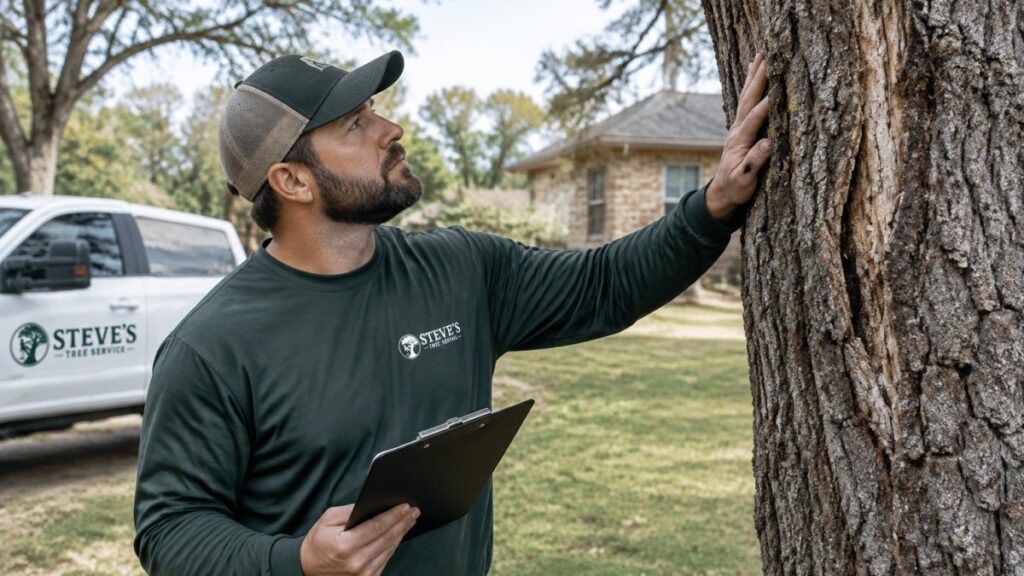
Last Updated: November 7, 2026
Quick Summary
To assess tree failure risk, check the trunk, roots, and crown for defects, then rate how likely failure is against how bad the outcome would be. A basic walk-around takes about 15 minutes and needs no special tools, and you should repeat it twice a year and after any big storm.
- Tree failure risk has three parts: failure likelihood, likelihood of impact, and consequences of failure.
- Check the trunk for cracks, cavities, mushrooms, or a hollow sound when tapped.
- Look for soil heaving, exposed roots, or a trunk leaning more than it used to.
- Rate likelihood and consequence as low, medium, or high on a tree risk assessment matrix.
- Call a certified arborist for a cracked trunk, hollow base, root mushrooms, or a lean over your house.
Table of Contents
- What Tree Failure Risk Actually Means for Your Yard
- Signs a Tree May Fall: What to Look For on Trunk, Roots, and Crown
- A Step-by-Step Homeowner Inspection Checklist
- Using a Tree Risk Assessment Matrix to Rate What You Find
- How Targets and Site Use Change the Risk Picture
- Filling Out a Tree Risk Assessment Form (and Reading a Report Example)
- When to Stop Inspecting and Call a Certified Arborist
- Schedule a Free Tree Risk Evaluation with Steve’s Tree Service LLC
- Frequently Asked Questions
What Tree Failure Risk Actually Means for Your Yard
Tree failure risk is the chance that all or part of a tree will break and hit something you care about. Homeowners can think of it as a simple question: how likely is this tree to come down, and what would it hit if it did? A tall oak far from your house carries less risk than a smaller, cracked tree leaning over your roof.
Tree failure means a trunk snaps, a large limb drops, or the whole tree tips over. Tree risk assessment is the process of looking for warning signs and weighing them against what sits below.
The Three Parts of Every Tree Risk Assessment
Every assessment boils down to three parts:
- Failure likelihood: how likely is this tree or branch to break?
- Likelihood of impact: would it actually hit a person, car, roof, or fence?
- Consequences of failure: how bad would the damage be if it did?
A dead branch over an empty back corner is low risk. That same branch over a driveway where kids play is a different story. All three parts matter together, not on their own.
Signs a Tree May Fall: What to Look For on Trunk, Roots, and Crown
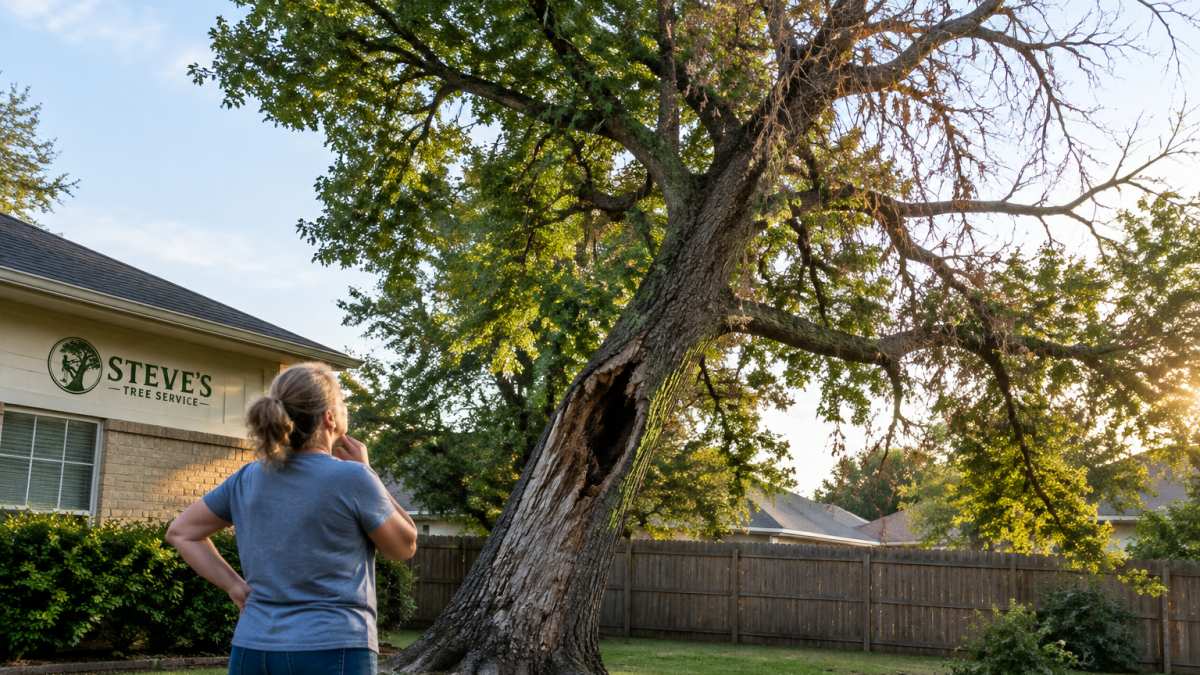
The clearest signs a tree may fall show up in three places: the trunk, the roots, and the crown. Check each one from the ground, at a distance, and never stand directly under the tree.
- Trunk: cracks, deep cavities, mushrooms growing on the bark, or a hollow sound when tapped
- Roots: soil heaving up on one side, exposed roots, or a trunk that leans more than it used to
- Crown: thin, sparse leaves in season, or dead wood scattered through the top
Dead, Broken, and Hanging Branches
Dead branches have no leaves and snap easily. Broken branches may still hang by a strip of bark, and hanging branches are the most dangerous because they can drop without warning. Look for bark peeling away and bare wood exposed. If a large dead limb sits over a walkway, roof, or power line, treat it as urgent.
A Step-by-Step Homeowner Inspection Checklist
A basic walk-around takes about 15 minutes and needs no special tools. Work through this checklist twice a year and after any big storm. Approach every tree from the outside first, and never stand directly under a tree with dead branches or a cracked trunk.
Step 1: Survey from a distance. Stand back at least the height of the tree (or as far as your yard allows) and look at the whole tree. Note any lean that is new or worsening, dead tops, or large dead branches. Check whether the tree is leaning toward a house, driveway, or play area.
Step 2: Inspect the crown. Look for dead, broken, or hanging branches. Dead branches have no leaves in season and may have peeling bark. Hanging branches are the most dangerous because they can drop without warning. Also note sparse leaves or dieback in the top of the tree, which can signal root or trunk problems.
Step 3: Examine the trunk. Walk around the tree and check for cracks, deep cavities, seams, or mushrooms growing on the bark. A hollow sound when you tap the trunk can indicate decay. Look for bark that is peeling away or sunken areas.
Step 4: Check the base and roots. Look for soil heaving up on one side, exposed roots, or a trunk that flares oddly at the ground. Mushrooms at the base are a red flag for root rot. Note any recent leaning that was not there before.
Step 5: Identify targets. For each tree, note what sits beneath it: house, shed, driveway, fence, patio, play set, or a spot where people often walk or gather. The same tree poses different risk depending on what it could hit.
Step 6: Check for power lines. Look for branches touching or near power lines. Never attempt to prune anything near lines yourself; call the utility or a professional.
Step 7: Photograph and date. Take photos of anything that looks off, and note the date. This helps you track changes over time and gives an arborist a clearer picture if you call one.
For a fuller list of warning signs, see our guide on signs a tree is hazardous. If you suspect root trouble, this guide on preventing tree root damage explains how root problems develop. You can also read more on identifying dead trees before they fall.
Watch out: Do not stand under a tree with hanging limbs or a cracked trunk while inspecting. If you see a hanging limb over a walkway or a new lean toward a structure, stop and call a professional rather than trying to fix it yourself.
Using a Tree Risk Assessment Matrix to Rate What You Find
A tree risk assessment matrix combines two things: how likely failure is, and how bad the outcome would be. Rate each on a simple low, medium, or high scale, then read across.
| Failure Likelihood | Low Consequence | Medium Consequence | High Consequence |
|---|---|---|---|
| Low | Low risk | Low risk | Medium risk |
| Medium | Low risk | Medium risk | High risk |
| High | Medium risk | High risk | High risk |
How to assign likelihood: Low means the tree looks sound with no visible defects. Medium means there are minor defects (small cracks, some dead wood) but nothing severe. High means there is a significant defect (large cavity, cracked trunk, mushrooms at the base, new lean) that could lead to failure.
How to assign consequence: Low means the target is rarely occupied or of low value (empty corner, fence). Medium means occasional use (driveway, patio). High means frequent use or high value (house, play area, bedroom window).
What the ratings mean for you:
- High risk: Call a professional now. Do not wait. Keep people and pets away from the area until it is assessed.
- Medium risk: Monitor closely and prune where needed. Consider limiting access to the area during storms. Reassess after any major weather event.
- Low risk: Keep an eye on it at your next scheduled check. No immediate action needed.
A common pattern is to overrate likelihood when you are unsure. If in doubt, treat a defect as medium rather than low, and get a second opinion from a qualified arborist if the tree is near a high-consequence target.
Watch out: The matrix is a guide, not a guarantee. A tree rated low risk can still fail in extreme weather, and a high-risk rating does not always mean removal is the only option. Use the rating to decide urgency, not to skip professional advice when a target is high-consequence.
How Targets and Site Use Change the Risk Picture
The same tree can be safe in one spot and risky in another. In tree risk terms, a target is anything that could be hit: a house, a shed, a parked car, a patio, or a person. How you use your yard changes the risk.
A tree over an unused back corner is low concern. Move a swing set under it, and the risk climbs fast. High-occupancy areas like driveways and play spaces raise the consequences of any failure. Wind and storm damage make weak trees fail more often, so a leaning tree near a bedroom window deserves a closer look.
Filling Out a Tree Risk Assessment Form (and Reading a Report Example)
A tree risk assessment form is simply a written record of what you found. Note the tree’s location, species, size, defects, targets, and your risk rating. Date each entry so you can track changes over time.
What a Tree Risk Assessment Report Example Should Show You
A good tree risk assessment report example lists the tree, the defects found, the targets below, a risk rating, and a recommended action with a timeframe. It should also state what was not checked. A report is a snapshot, not a guarantee, so plan to reassess after storms or major changes.
When to Stop Inspecting and Call a Certified Arborist
Stop and call a certified arborist the moment you see a cracked trunk, a hollow base, mushrooms at the roots, or a tree leaning over your house. These are beyond what a homeowner should handle. A qualified arborist can confirm the risk and recommend pruning, cabling, removal, or monitoring.
Never climb a tree or cut large limbs near power lines yourself. For a tree that is already down or storm-damaged, our emergency tree service is ready to help.
Schedule a Free Tree Risk Evaluation with Steve’s Tree Service LLC
Some risks are hard to judge from the ground, and a trained eye catches what a checklist cannot. Weatherford homeowners trust Steve’s Tree Service LLC for safe tree removal, professional tree trimming, and dependable cleanup. With over 12 years of experience, Christian values, and 73+ five-star Google reviews, we take pride in treating every property like our own.
We offer free estimates and thorough property cleanup, so your yard is left in good shape. Contact Steve’s Tree Service LLC to book your free evaluation. Our team handles hazardous tree removal, storm cleanup, and stump removal, and we treat every home with respect.
If a tree on your property has you worried, do not wait for the next storm to find out. Get started with Steve’s Tree Service LLC and schedule a free tree risk evaluation to protect your home and family.
Frequently Asked Questions
What are the three components of tree risk assessment?
Every tree risk assessment looks at three things: the likelihood that the tree or a part of it fails, the likelihood that it hits something when it does, and how serious the consequences would be. A tree with a cracked trunk in an empty field scores lower than the same tree leaning over a bedroom. Understanding all three parts helps you judge tree failure risk instead of panicking over every dead branch.
What signs indicate that a tree may fail?
Watch for mushrooms or conks on the trunk, cavities and deep cracks, bark peeling away from the wood, a trunk that leans more than it used to, and soil heaving or exposed roots at the base. Dead or hanging branches in the crown are also warning signs. Any one of these on a tree near your house or driveway is a good reason to stop inspecting and call a certified arborist for a professional look.
Can a tree with a hollow trunk still be safe?
Sometimes, yes. A hollow trunk does not automatically mean the tree will fail, because the living wood around the cavity may still carry plenty of load. What matters is how much sound wood remains and where the hollow sits. This is exactly the judgment call a qualified arborist makes during a tree risk assessment, often with tools that measure resistance through the trunk.
When should a homeowner call an arborist for a tree risk assessment?
Call once you spot a structural defect you cannot explain, when a tree leans toward your home, power lines, or a driveway, or after any storm that dropped large limbs. Also call if you simply are not sure. A certified arborist can put a risk rating on the tree, explain your mitigation options like pruning or removal, and set a monitoring schedule so you know when to check again.
