
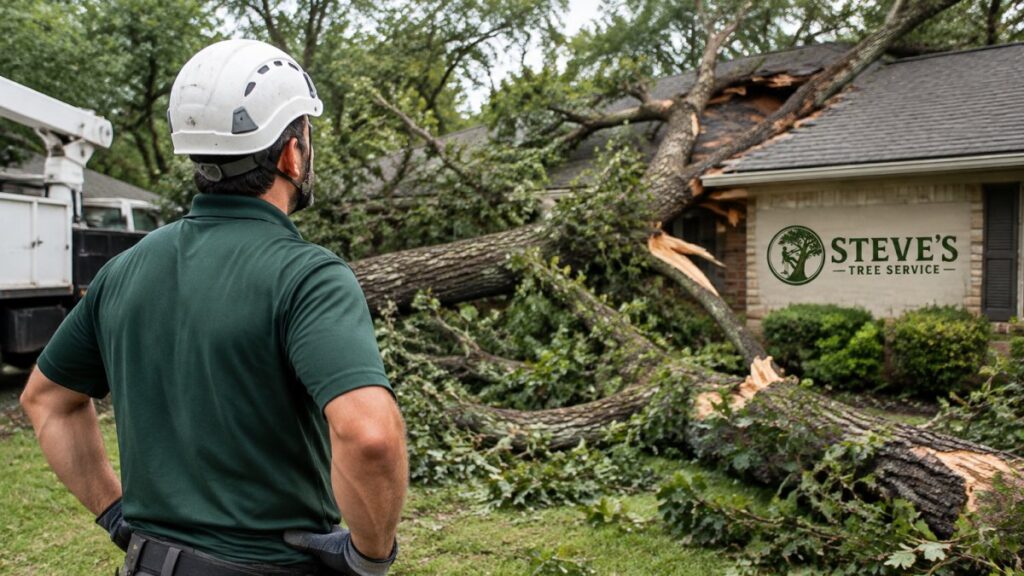
Last Updated: November 5, 2026
Quick Summary
In a tree emergency, get everyone out of the house and away from the tree first, then call 911 if anyone is hurt or a line is down. Keep a wide distance, treat every downed line as live, and never go back inside for belongings.
- Call 911 first if someone is hurt or trapped, then the utility company.
- Treat every downed power line as live and keep everyone far away.
- Never enter a home with a tree on the roof to grab belongings.
- Ask any tree service for a certificate of insurance and verify it with the insurer.
- Call a professional when a tree is on a structure or tangled with a line.
Table of Contents
- What to Do First in a Tree Emergency
- What to Do When a Tree Falls on Your House
- Fallen Tree on Power Line Safety: What You Must Know
- Storm-Damaged Tree Safety: Spotting Hidden Hazards
- What to Do With Fallen Tree Branches
- How to Verify an Emergency Tree Contractor
- When to Call Steve’s Tree Service for Emergency Help
- Frequently Asked Questions
What to Do First in a Tree Emergency
A tree emergency happens when a tree or large limb has already fallen, is actively falling, or is leaning in a way that could hit a person, a home, a vehicle, or a utility line. For a step-by-step walkthrough of what to do right now, see our emergency tree removal article.
Start with these steps, in this order:
- Get everyone out of the house and away from the tree.
- Call 911 if anyone is hurt or a line is down.
- Keep a wide distance and watch for movement.
- Check for power lines, gas smells, and damage you can see from safety.
Do not walk under a leaning tree to “take a quick look.” A common mistake is treating a half-fallen tree as a finished event. It is not. Roots and soil can still be shifting.
Evacuate and Account for Everyone
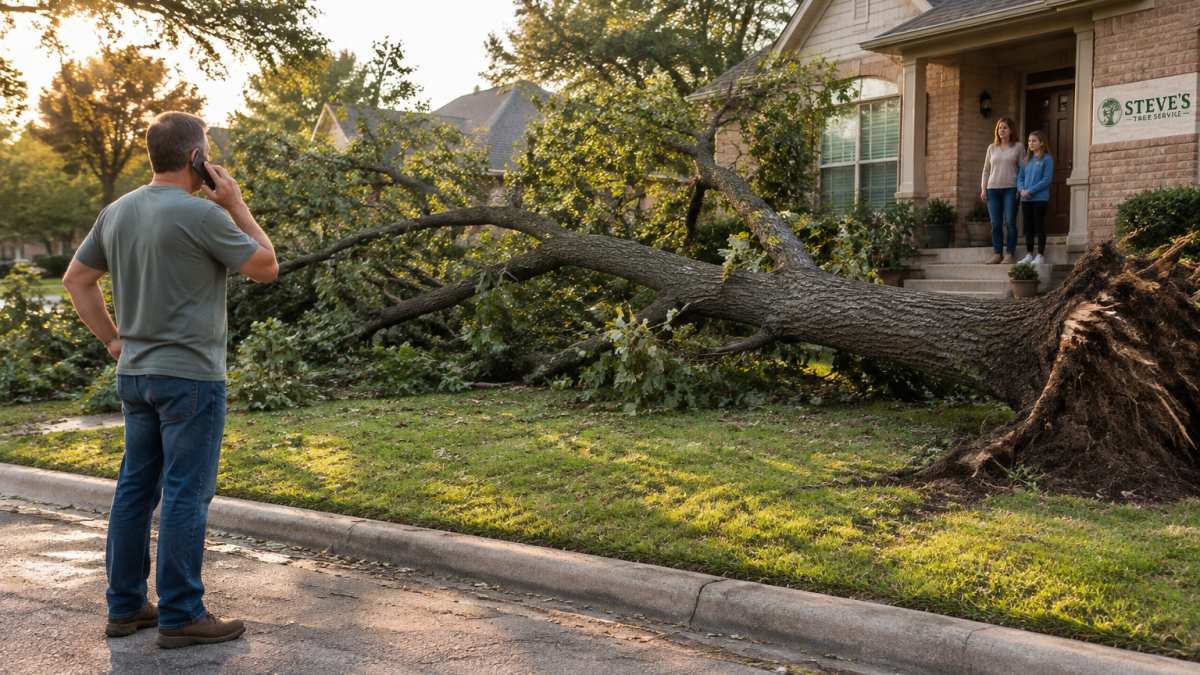
Get every person out of the house and off the lawn before anything else. Move toward the street or a neighbor’s yard, away from the direction the tree is leaning. Count heads out loud. Check closets, bathrooms, and the backyard for kids and guests. Then bring pets out on a leash or in a carrier, and keep them close.
Once everyone is clear, nobody goes back inside for a phone charger, a purse, or a pet toy. If the tree is touching the roof, the structure may be stressed in ways you cannot see.
Keep Your Distance and Set Up a Safe Zone
A safe zone is an area well beyond the reach of the tree, its branches, and anything it could pull down with it. Set one up and keep bystanders, children, and pets behind it.
Watch the tree from that spot for a few minutes. Look for:
- Cracks or snapping sounds from the trunk
- Soil lifting or cracking at the base
- The tree shifting or rocking
- Limbs dropping without wind
Any of these means the tree is still moving. Stay back and call for help. For a closer look at the warning signs, see our guide to hazardous tree warning signs.
Decide Who to Call and When
In the first minutes, you may need to make several calls. Use this simple decision tree to prioritize:
- If someone is hurt or trapped: Call 911 immediately. Then call the utility company if a power line is involved.
- If a power line is down but no one is hurt: Call the utility company first. Call 911 only if there is fire, sparking, or immediate danger to others.
- If a tree is leaning but not touching a line or structure: Call a professional tree service for an assessment. If it is near a power line, also notify the utility.
- If a tree has fallen on your house but no one is hurt: Call 911 if you smell gas or see sparking; otherwise, call your insurance company and a tree professional.
Keep these numbers handy: 911, your utility company’s emergency line, and a trusted tree service. Program them into your phone now so you are not searching under stress.
Watch out: Never assume a downed line is dead. Always treat it as live and keep everyone far away until the utility company confirms it is safe.
What to Do When a Tree Falls on Your House
When a tree falls on your house, get people out first, then call 911 if anyone is trapped, hurt, or if you smell gas or see sparking.
From outside, note what you can see: sagging roof lines, cracked walls, broken windows, or a tree resting on the structure. Tell the 911 dispatcher and your utility company what you observe.
Watch out: never enter a home with a tree on the roof to grab belongings. The roof and walls may be holding weight they were never built for, and a second collapse is a real risk.
Document the damage with photos from the ground once it is safe. Your insurance company will want them. Keep receipts for any emergency work.
Fallen Tree on Power Line Safety: What You Must Know
Treat every downed line as live, even if the power looks out. A fallen tree on a power line is a job for the utility company, not a homeowner and not a tree crew working alone.
Downed Wires and Electrical Equipment
Stay far back and keep others away. Assume the ground near a downed wire can carry current. Do not touch the tree, the wire, a fence, a puddle, or anything the line is touching. Call 911 and the utility company, then wait.
Here is the call order for common situations:
| Situation | First call | Then |
|---|---|---|
| Someone hurt or trapped | 911 | Utility company |
| Line down, no injuries | Utility company | 911 if fire or sparking |
| Tree leaning, no line contact | Tree professional | Utility if it nears lines |
| Tree on house, no injuries | 911 if unsafe | Insurance and tree pro |
Never try to move a limb off a wire with a pole, a rope, or a ladder. This is how people get killed.
Get a Free Tree Service Estimate →
Storm-Damaged Tree Safety: Spotting Hidden Hazards
A storm-damaged tree can look fine and still be dangerous. The damage is often overhead or underground, where you cannot see it. Look from a distance and never stand under the canopy.
Hanging Branches, Leaning Trees, and Soil Stability
Check for hanging branches and loose limbs caught in the canopy, waiting to drop. A leaning tree that was straight before the storm is a red flag. So is soil stability: cracked ground, a lifted root plate, or a new tilt at the base.
Other hazards to watch:
- Limbs resting on the roof or a fence
- A tree leaning toward the house or a vehicle
- Cracks running up the trunk
- Mushrooms or soft wood at the base
If you see any of these, keep the area clear and call a professional arborist for a hazard assessment. Our article on signs a tree is hazardous covers what to look for.
What to Do With Fallen Tree Branches
Small fallen branches you can safely reach on open ground can go in your yard waste. Anything large, tangled, near a line, or resting on a structure should wait for a pro. Storm cleanup is heavy work, and cutting under tension is where most chainsaw injuries happen.
If you want the mess handled in one pass, storm cleanup covers fallen limb removal, debris hauling, and a clean yard when the crew leaves. That matters if you have spent a weekend raking before.
How to Verify an Emergency Tree Contractor
Before you hire anyone for emergency tree work, confirm they are insured, ask for proof in writing, and get the scope and cleanup terms in the estimate. A storm brings out plenty of people with a truck and a chainsaw. Some are excellent. Some are not. Here is how to tell the difference.
Check Licensing and Insurance
Ask any tree service for a certificate of insurance and call the insurer to verify it is current. Do not accept a verbal assurance. A legitimate company will provide this without hesitation. If they cannot, walk away.
Licensing requirements vary by state and municipality. Ask if they hold any required local licenses and verify with your city or county. Some states require a specific tree care license; others do not. A professional will know the rules for your area.
Ask the Right Questions
Get clear answers to these questions before any work begins:
- Are you insured, and can you show me the certificate?
- Is the cleanup and debris hauling included?
- Will the stump be ground out, and is that separate?
- How soon can you get here, and what is the estimate based on?
- Do you have references from jobs like mine?
- Are you a certified arborist or do you have one on staff?
A certified arborist is a professional who has passed an exam and meets ongoing education requirements through a recognized body like the International Society of Arboriculture (ISA).
Watch for Red Flags
Be wary of anyone who:
- Demands full payment upfront or only accepts cash.
- Cannot provide a written estimate or proof of insurance.
- Pressures you to decide immediately or offers a “today only” discount.
- Has no local address or references.
- Suggests you can skip permits or proper disposal.
Watch out: Never let anyone work on a tree near power lines unless they have confirmed coordination with the utility company. This is not a job for a general handyman.
Get the estimate in writing before work starts. For a fuller checklist, read our guide on finding reliable tree services.
When to Call Steve’s Tree Service for Emergency Help
Call a professional when a tree is on a structure, leaning toward your home, tangled with a line, or too big to handle safely. Weatherford homeowners trust Steve’s Tree Service LLC for safe tree removal, professional tree trimming, and dependable cleanup. With over 12 years of experience, Christian values, and 73+ five-star Google reviews, we take pride in treating every property like our own.
We offer free estimates. If you need help right now, request emergency tree service and we will get a crew headed your way.
Frequently Asked Questions
What is considered an emergency tree removal?
An emergency tree removal is when a tree poses an immediate threat to people, structures, or utilities. Examples include a tree leaning toward your house, a fallen tree blocking an exit, or branches resting on power lines. If you see sparking wires, smell gas, or the tree is actively moving, call 911 and your utility company first. For trees that are unstable but not yet causing immediate danger, contact a professional tree service to assess the situation.
Is it safe to remove a fallen tree yourself?
No. Fallen trees can be under tension, and cutting them without training can cause the trunk to roll, kick back, or release stored energy unexpectedly. Chainsaw injuries are common in DIY cleanup. There is also the risk of hidden power lines or gas leaks beneath the debris. Keep your distance and call a professional. A certified arborist or emergency tree service has the protective equipment and experience to handle the job safely.
What should I do if a tree falls on my house?
First, get everyone out of the house and away from the structure. Do not go back inside to retrieve belongings. Call 911 if anyone is injured or if you smell gas or see sparking wires. From a safe distance, check for downed power lines and contact your utility company. Then call your insurance agent to report the damage and document everything with photos. Do not attempt to move the tree or make repairs yourself. A professional tree service can safely remove the tree and assess structural damage.
How can I tell if a storm-damaged tree is dangerous?
Look for leaning, cracked trunks, hanging branches, or exposed roots. A tree that has shifted from its original position or has soil heaving around the base is unstable. Also watch for trees with large broken limbs still attached or trees that are tangled with power lines. From a safe distance, check for movement in the canopy even when there is no wind. If you see any of these signs, keep everyone away and call a professional arborist for an assessment.
A fallen tree is stressful, and the safest move is often the simplest one: get everyone clear, make the right calls, and let trained hands do the cutting. Steve’s Tree Service LLC handles emergency tree removal, storm cleanup, and stump removal with free estimates and a full cleanup when we leave. Get started with Steve’s Tree Service LLC and get your yard safe and clear again.
