
Table of Contents
- Why Tree Trimming for Storm Safety Matters
- How to Prepare Trees for a Storm: A Season-by-Season Schedule
- Spotting Hazardous Tree Branches Before They Fail
- Proper Pruning Cuts That Reduce Wind Resistance
- DIY vs. Professional Tree Care: A Decision Guide
- What to Do With Fallen Tree Branches After a Storm
- Storm-Damaged Tree Cleanup: Safe Next Steps
- Frequently Asked Questions
Last Updated: October 19, 2026
Why Tree Trimming for Storm Safety Matters
Tree trimming for storm safety means removing weak, dead, and overextended branches before high winds and heavy rain turn them into falling hazards.
Most guides treat trimming as a cosmetic chore. In practice, it is structural risk reduction: a dead limb over a roof is a projectile waiting for the right gust.
Below: a season-by-season schedule, a pre-storm inspection checklist, the cuts that reduce wind load, and when to call a professional.
Storm damage is usually predictable. A tree that drops a limb in a storm almost always had a visible defect weeks or months earlier. The inspection matters more than the cleanup.
How to Prepare Trees for a Storm: A Season-by-Season Schedule
Preparing trees for a storm works best as a year-round habit, not a panic response the week before severe weather.
Our recommended schedule:
- Late winter (dormant season): Do the heavy structural pruning. Trees are dormant, wounds close cleanly, and you can see the branch structure without leaves in the way.
- Early spring: Check for winter breakage and remove damaged limbs before new growth hides them.
- Summer: Light touch-ups only. Remove dead branches and watch for storm damage after heavy rain.
Timing matters because pruning cuts are wounds; dormant-season cuts give the tree its best chance to seal before insects and disease become active.
The Pre-Storm Inspection Checklist
Run this checklist before storm season arrives, about 20 minutes per tree catches most problems early.
- Look up: are there dead branches with no leaves during growing season?
- Check for cracks or splits where a branch meets the trunk
- Look for branches that cross or rub against each other
If you check three or more boxes, that tree needs attention before the next storm. A certified arborist can confirm what you are seeing.
Spotting Hazardous Tree Branches Before They Fail
Hazardous tree branches share a few recognizable warning signs, and learning them is the best thing a homeowner can do for storm safety. A branch that fails in high winds usually gave plenty of notice.
The most common red flags:
- Dead branches with brittle, dry wood or no leaves in season
- Cracks at the branch collar where the limb attaches to the trunk
- Weak unions where two limbs form a narrow V instead of a strong U
A branch with any of these signs is a candidate for removal, don’t wait for the storm to decide for you.
Assessing Tree Health and Structural Weakness
Tree health and structural weakness are different things, and both matter. A tree can look green and full while hiding a structural defect that will bring it down.
Structural weakness shows up in the trunk and the branch unions, not the leaves. Look for:
- A hollow or soft trunk when tapped
- Bark peeling away from the wood
- A lean that has worsened over time
Tree health shows up in the canopy: thin, yellowing foliage, tip dieback, and sparse growth point to a stressed tree, and stressed trees are more likely to shed limbs in severe weather.
Do not stand under a tree to inspect it from below. Falling branches are the leading cause of injury during tree work. Inspect from a distance, and call a professional for anything close to power lines or your roof.
Proper Pruning Cuts That Reduce Wind Resistance
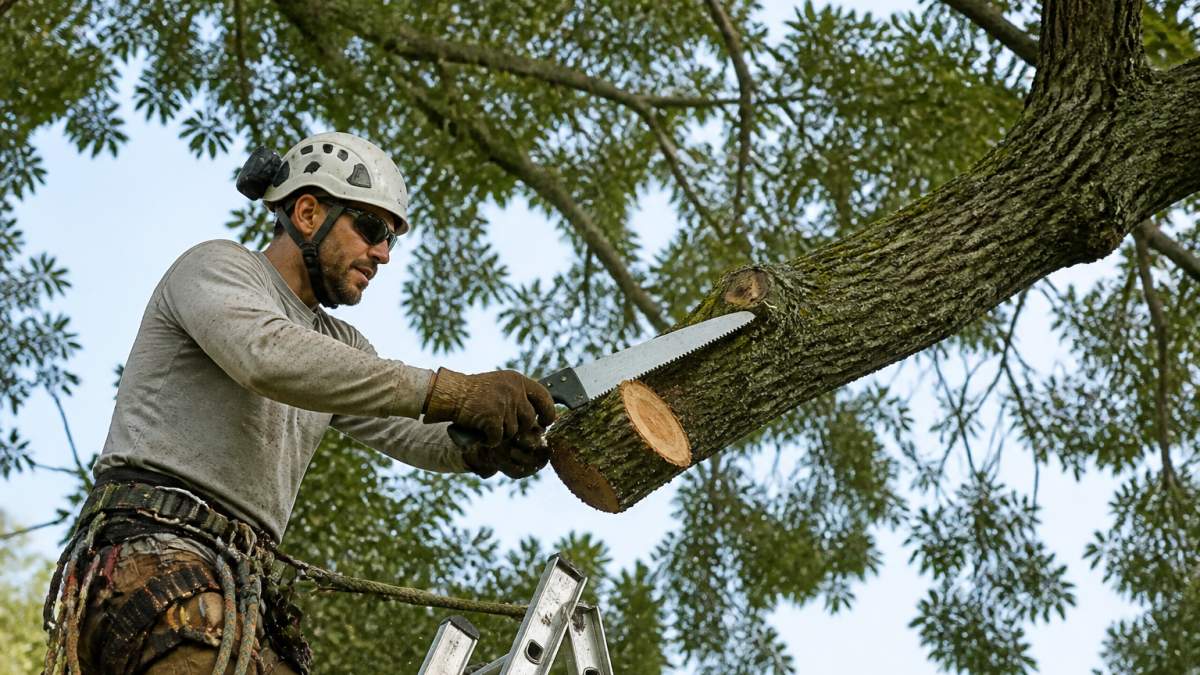
Proper pruning cuts reduce wind resistance by opening the canopy so air passes through instead of pushing against a solid wall of foliage. A dense crown acts like a sail, transferring wind force into branch unions and the trunk; selective thinning lowers that sail area without stripping the leaves the tree needs to feed itself.
How Crown Thinning Actually Lowers Wind Load
Crown thinning removes selected interior branches, typically the weaker, crossing, and poorly attached ones, so wind moves through the crown rather than stalling against it. The goal is a canopy slightly more open from below, not one hollowed out.
Working principles most practitioners follow:
- Remove no more than about 25 percent of the live canopy in a single season. More than that stresses the tree and can trigger weak, fast regrowth that is more brittle than what you removed.
- Thin evenly through the crown, not just the outside. Cutting only the outer tips creates a shell of foliage on long, whip-like branches, the opposite of storm-resistant structure.
- Prioritize the weak wood. Dead, cracked, crossing, and narrow-V unions come out first. Healthy, well-attached limbs stay.
Wind load also depends on where the canopy sits. A limb extending far past the rest of the crown has a long lever arm, so the same wind puts far more stress on its attachment point than a shorter limb of equal weight.
The Three-Cut Method, Step by Step
The three-cut method is the standard for removing a branch without tearing bark down the trunk:
- Undercut about 6 inches out from the trunk, cutting a third of the way through the branch from below.
- Top cut a few inches further out until the branch drops. The undercut stops the falling limb from ripping a strip of bark off the trunk.
- Final cut on the remaining stub, just outside the branch collar, the swollen ring of tissue where the branch meets the trunk.
That final cut is where most homeowners go wrong. Cutting flush removes the branch collar, the tree’s natural healing zone, while a long stub invites rot. The correct cut sits just outside the collar, angled so water runs off rather than pooling.
Common Pruning Mistakes and Over-Pruning Risks
Over-pruning is the mistake we see most often, and it does the opposite of what homeowners intend. Strip too much canopy and you reduce the tree’s ability to make food, weakening it and pushing weak, fast regrowth.
The biggest pruning mistakes:
- Flush cuts that remove the branch collar and slow healing
- Topping a tree, which forces weak, fast regrowth and leaves large wounds that rarely close
- Removing more than a quarter of the live canopy in one season
A healthy tree can lose a small fraction of its live canopy in a season; anything more is a stress event, not a trim.
Topping and heavy crown reduction are not storm-safety techniques. They create weak regrowth and large wounds that leave the tree more hazardous than before. If someone recommends topping your tree to protect it from storms, get a second opinion from a certified arborist.
DIY vs. Professional Tree Care: A Decision Guide
Not every branch needs a professional, but some absolutely do. Use this guide:
| Situation | DIY Safe? | Why |
|---|---|---|
| Small dead twigs within reach | Yes | Low risk, small cuts |
| Branches under 2 inches thick, on the ground | Yes | Manageable with hand tools |
| Limbs over the roof or driveway | No | Falling hazard, property damage risk |
| Anything near power lines | No | Electrocution risk, call the utility first |
| Large dead or leaning trees | No | Structural failure risk |
| Storm-damaged trees still standing | No | Hidden cracks, unpredictable failure |
The rule we give homeowners is simple: if the branch is above your head, thicker than your arm, or anywhere near a wire or your roof, stop. That is professional work.
After any major pruning, ask for the debris to be hauled away, not just piled at the curb. Most reputable crews include full cleanup in the quote. Confirm it in writing before work starts.
What to Do With Fallen Tree Branches After a Storm
Fallen tree branches after a storm are a safety issue first and a cleanup issue second. Before you touch anything, check for downed power lines and call your utility if you see any. Treat every wire as live and keep children and pets away until the utility confirms it is safe.
Document Before You Move Anything
This is the step most homeowners skip, and the one that matters most if you file an insurance claim. Before you move a single branch:
- Photograph the damage from several angles, the fallen limb, what it hit, and the tree it came from.
- Photograph the stump or break point on any tree that lost a major limb, so the cause is visible.
- Note the date and time the damage occurred, and keep any receipts for emergency work or temporary repairs.
- Do not haul debris to the curb until your insurer or adjuster has seen it or told you it is not needed. Many policies require you to show the damage before disposal.
Homeowners often clean up fast, then discover the adjuster wanted to see the debris in place. A few photos taken before cleanup prevent that problem.
Clear, Sort, and Dispose in the Right Order
Once the area is safe and documented, work in this order:
- Clear a path to your door and driveway first, so you and emergency services can move freely.
- Separate debris into small branches, large limbs, and trunk sections, many municipalities handle these differently.
- Check local pickup rules for yard waste before hauling anything to the curb. Some areas require bundles of a certain size, some require cut ends facing the street, and some do not pick up trunk sections at all.
- Stack cut ends toward the street if your municipality requires it.
Do not burn storm debris without checking local burn rules and burn bans. And do not use a chainsaw on a limb under tension or pinned under another, that is how kickback and pinch injuries happen. Leave sprung or loaded limbs to a professional.
When a Fallen Limb Means the Tree Is Still Dangerous
A fallen branch is sometimes the whole story, and sometimes a warning. A tree that dropped a major limb may still be compromised, and the next wind event can finish the job.
Look up before you clean up. A tree that shed a limb is worth a second look for:
- Hanging branches caught in the canopy above your work area
- Split trunks or large cracks in major limbs
- Exposed roots from soil shifting
If you see any of these, stop cleanup and get an assessment before working underneath the tree. A damaged tree with a split trunk or exposed roots is often a removal, not a trim, and that is a job for a professional with the right equipment and insurance.
Keep a simple storm file, photos, dates, receipts, and any arborist reports, in one folder. If you file a claim, having it organized shortens the process and reduces disputes over what was damaged and when.
Storm-Damaged Tree Cleanup: Safe Next Steps
Storm-damaged tree cleanup starts with a hazard assessment, not a chainsaw. A tree that survived the storm may still be compromised.
When you call, ask three things: Are you insured? Is cleanup included? How soon can you get here? At Steve’s Tree Service LLC, we offer free estimates and treat every property with care. As one recent customer put it, “He does great work, professional and takes care of all the mess.”
Frequently Asked Questions
What tree branches should be trimmed before a storm?
Focus on dead, damaged, and weak limbs first, then any branches that hang over your roof, driveway, or power lines. Remove overextended branches with heavy end weight and thin the canopy so wind passes through instead of catching. Avoid cutting more than about 25% of the live canopy at once, since over-pruning stresses the tree and can make it more likely to fail. For large limbs near structures or lines, call a professional arborist rather than working at height yourself.
Can tree trimming prevent storm damage?
It reduces risk but cannot eliminate it. Selective pruning removes hazardous tree branches and lowers wind load on the canopy, which cuts the chance of limb failure during high winds. Crown thinning and removing dead wood are the most effective steps. A tree with structural weakness, root damage, or a severe lean may still fail no matter how it is trimmed, which is why an assessment matters before storm season.
Should I trim trees myself or hire a professional?
Trim small branches yourself only if they are within easy reach from the ground and well away from power lines. Anything requiring a ladder, climbing, or a chainsaw overhead belongs with a professional. Tree work is among the most dangerous trades, and a hazardous tree leaning toward a house or near lines is not a DIY job. A free estimate from a local arborist also tells you whether the tree can be saved with trimming or needs removal.
Will homeowners insurance cover tree removal after a storm?
Coverage depends on the policy and the situation. Many policies pay to remove a tree that falls on a covered structure, blocks a driveway, or hits a fence, but often not for a tree that simply falls in the open yard. Document the damage with photos before cleanup and keep receipts. Ask your insurer about limits before storm season so you know what to expect, and get a written estimate from a tree service before work begins.
Storms do not wait for a convenient week, and neither should your preparation. If you have a dead tree, a leaning limb, or storm damage you are not sure about, get it looked at before the next system rolls through. Steve’s Tree Service LLC offers free estimates, full property cleanup, and more than 12 years of experience handling hazardous trees safely. Get a quote today and protect your home before the weather decides for you.