
Table of Contents
- Emergency Storm Tree Cleanup Services: What to Do First
- Storm Damage Assessment and Hazardous Tree Identification
- Insurance Coverage for Fallen Trees: What Homeowners Need to Know
- How to Hire a Professional Tree Service You Can Trust
- Storm Damage Tree Removal Cost: What Affects Your Quote
- Post-Storm Tree Health Assessment and Recovery
- Conclusion: Protecting Your Property with Expert Storm Tree Cleanup
- Frequently Asked Questions
Last Updated: October 2, 2026
Emergency Storm Tree Cleanup Services: What to Do First
When a storm drops a tree across your driveway at 2 a.m., the first hour matters more than the next three days. Emergency storm tree cleanup services exist to remove that immediate danger, but knowing what to do before the crew arrives protects both your family and your property. This guide from Steve’s Tree Service LLC walks through the decisions homeowners face in the aftermath of high wind damage, from the moment the storm passes to the final debris haul-away.
The single most important rule: never approach a fallen tree that is touching or near a power line. Treat every downed line as live, keep everyone at least 10 metres back, and call your utility’s emergency line before you call anyone else. According to the Occupational Safety and Health Administration’s guidance on tree care hazards, contact with energized lines remains one of the leading causes of fatality in tree work, and that risk applies to homeowners with a chainsaw just as much as to professionals.
Below, we break down the sequence that keeps people safe: secure the perimeter, assess the damage, document everything for your insurer, and bring in qualified help for anything you cannot handle from the ground.
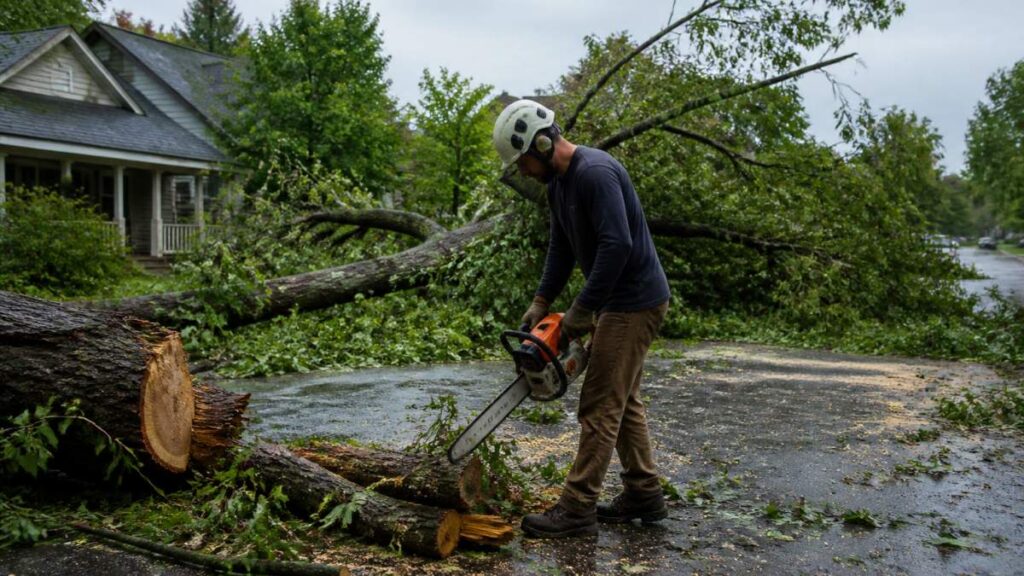
Immediate Safety Steps After a Storm
Your first moves are about containment, not cleanup. Walk the property only in daylight if you can, and scan for hazards before you step outside: leaning trunks, hanging limbs, cracked branches still attached overhead, and anything near electrical service drops or gas meters.
A common mistake is heading straight for the biggest downed tree. The more dangerous hazards are often the ones still standing. A tree that has lost half its root plate can topple days after the storm with no warning. If a trunk is visibly lifting soil on one side, stay clear and mark the area.
- Keep children and pets indoors until the yard is cleared
- Never use a chainsaw on a limb under tension or above shoulder height
- Do not burn storm debris unless your local rules allow it
- Photograph hazards from a safe distance before anything moves
DIY vs. Professional Safety Thresholds
Some storm debris is genuinely a homeowner job. Branches under a few centimetres in diameter, lying flat on open ground with no overhead hazards, can be cut and stacked with hand tools or a small saw. That is the honest dividing line.
Everything else belongs to a professional. If a tree is leaning, if any part of it is off the ground and under load, if it is within reach of a structure or a line, or if the trunk diameter exceeds what a single person can control with one cut, stop. Root plate failure, spring poles, and barber-chair splits are the three situations that send experienced arborists to the hospital when they misjudge them. A homeowner has no margin for that error.
Never cut a fallen tree that is resting on a fence, vehicle, or structure. The wood is holding stored energy, and releasing it can whip the trunk or roll the log unpredictably. Mark it and leave it for a crew with the right rigging.
Storm Damage Assessment and Hazardous Tree Identification
A structured walk-through tells you what you are actually dealing with. Storm damage assessment is the process of inspecting trees and structures for hazards, documenting the damage, and separating what is cosmetic from what is dangerous. Do it once, thoroughly, rather than making repeated trips through an unsafe yard.
Work outward from the house. Check the roof line and gutters first, then move to the trees closest to the structure, then the perimeter. Note anything that is cracked, split, uprooted, or newly leaning. A tree that was straight last week and is not straight now is a hazard until a professional says otherwise.
Hazardous tree identification comes down to a short list of signals:
- Fresh soil heaving at the base, which points to root plate failure
- Vertical cracks in the trunk or a split fork with included bark
- Large dead limbs, called widowmakers, hung up in the canopy
- A sudden lean of more than a few degrees from the previous position
- Mushrooms or soft, spongy wood at the base of the trunk
If you see any of these, rope off the area and keep it clear. Do not park under it, do not store equipment near it, and do not let anyone work beneath it.
Insurance Coverage for Fallen Trees: What Homeowners Need to Know
Insurance coverage for fallen trees usually depends on where the tree landed, not who owned it. As a general rule, most homeowners policies cover the cost of removing a tree that has fallen on a covered structure, such as your house, garage, or fence (If a tree falls on your house, are you covered?). Removal of a tree that fell in the open yard, damaging nothing, is frequently excluded or capped at a modest limit. Because policy language varies widely, check your own declarations page or ask your adjuster directly rather than relying on general rules.
The part homeowners get wrong is timing.
Insurance Documentation Best Practices
Document before you clear. Photograph the fallen tree from multiple angles, including wide shots that show its position relative to the house, and close shots of any damage to structures, fencing, or vehicles. Include something for scale, like a tape measure or a familiar object, in at least one frame.
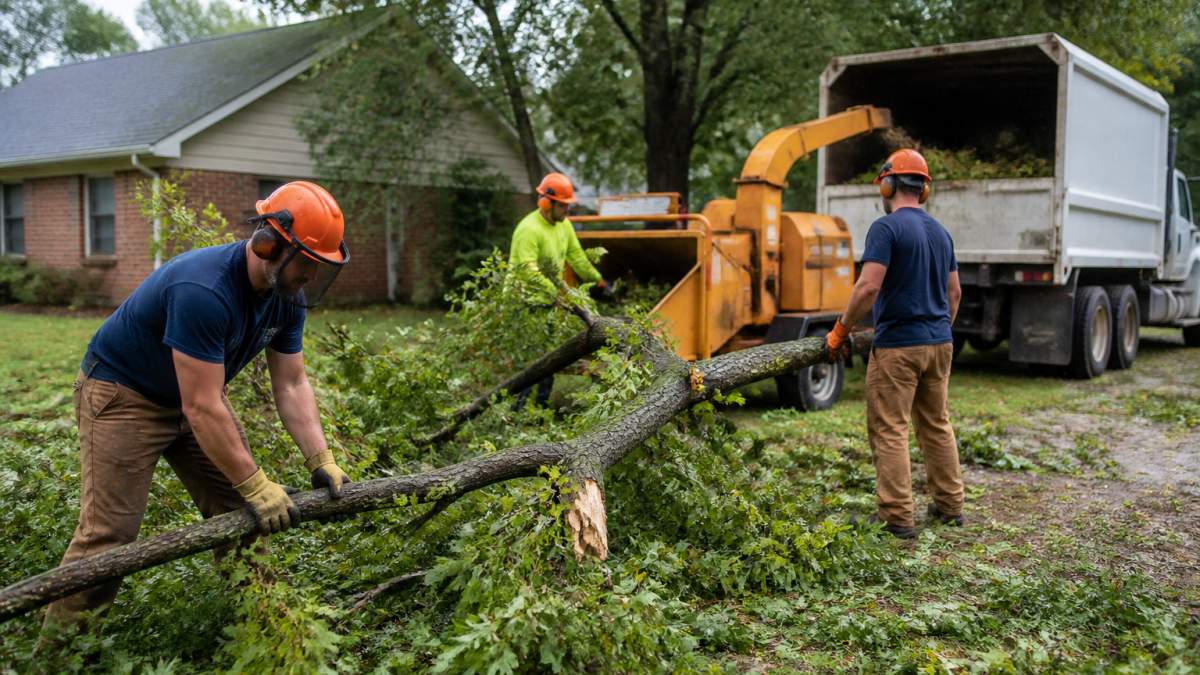
Ask the crew for a written scope of work before they start, listing what will be removed, what will be ground out, and what will be hauled away. Insurers accept itemised documentation far more readily than a single lump-sum invoice, and it protects you if the final bill changes.
How to Hire a Professional Tree Service You Can Trust
The right crew shows up prepared, insured, and willing to put the details in writing. How to hire a professional tree service comes down to four checks you can complete in a single phone call: proof of insurance, a written estimate, a clear cleanup commitment, and a physical address you can verify.
| What to Verify | Why It Matters | What to Ask For |
|---|---|---|
| Insurance | Protects you from injury claims | Certificate of insurance |
| Written estimate | Prevents surprise charges | Itemised scope and price |
| Cleanup terms | Confirms what gets hauled away | Chipping, hauling, raking listed |
| Stump grinding | Commonly a separate line item | Confirmed in or out of quote |
| Local presence | Faster emergency response | Verifiable business address |
Storm Damage Tree Removal Cost: What Affects Your Quote
Storm damage tree removal cost varies enormously because the work varies enormously. A small ornamental tree lifted off a lawn is a different job from a 20-metre oak leaning over a roof near service lines. Rather than quoting a number that will not hold, a good provider prices the specific job in front of them.
Several factors drive the quote:
- Size and species. Height, trunk diameter, and wood density all affect the time and equipment required.
- Lean and load. A tree under tension needs rigging, not just cutting.
- Proximity to structures and lines. Working over a roof or near power lines slows everything down and may require a crane or bucket truck.
- Access. A tree in an open field is cheaper to remove than one wedged between a fence and a shed.
- Stump grinding and hauling. These are frequently separate line items, so confirm what is included.
- Urgency. Emergency dispatch outside normal hours typically carries a premium.
Never accept a verbal quote for storm work. Ask for an itemised written estimate that separates removal, stump grinding, and debris hauling, so you can compare offers on equal terms and avoid surprise charges after the job.
Post-Storm Tree Health Assessment and Recovery
The trees that survive a storm are not automatically out of danger. Post-storm tree health assessment is the practice of evaluating surviving trees for hidden damage, then deciding whether they can recover with care or need to come down. Many of the worst failures happen weeks after the weather clears, when a weakened tree finally gives way.
Conclusion: Protecting Your Property with Expert Storm Tree Cleanup
Storm season tests every homeowner, and the difference between a manageable cleanup and a genuine hazard often comes down to who you call. If you are facing a downed tree, a leaning trunk, or debris you cannot safely handle, do not wait for the situation to get worse.
Frequently Asked Questions
How much does tree removal cost after a storm?
The cost depends on the tree’s size, location, and complexity. Removing a large tree near power lines or a home takes more equipment and time than a small tree in an open yard. Most homeowners insurance policies cover tree removal if the tree hits a covered structure. Steve’s Tree Service LLC offers free estimates, so you can get a clear quote before any work begins.
Does homeowners insurance cover tree cleanup after a storm?
Insurance coverage for fallen trees typically applies when the tree damages a covered structure like your home, fence, or shed. Most policies also cover removal if the tree blocks a driveway or ramp. However, if the tree simply falls in your yard without hitting anything, removal is usually your responsibility. Document everything with photos before cleanup starts to support your claim.
How quickly can I get emergency storm tree cleanup services?
Response times vary by provider and storm severity. Steve’s Tree Service LLC offers 24/7 emergency dispatch for hazardous situations like trees on homes or blocking access. During major storms, call as soon as it is safe to do so and be prepared to describe the situation clearly. Priority is typically given to trees threatening structures or power lines.
Who is responsible for damage from a tree blown over in a storm?
Responsibility depends on where the tree was rooted and what it damaged. If your neighbor’s tree falls on your house, your insurance usually covers the damage, and your insurer may seek reimbursement from your neighbor’s policy. If a tree from your property falls on a neighbor’s structure, their insurance handles it. An arborist assessment can help determine tree health and liability factors.