
Last Updated: October 25, 2026
Quick Summary
To find reliable tree services, diagnose what your tree actually needs first, then verify liability insurance and workers’ compensation by calling the insurer directly. Ask for written estimates with itemized scope, cleanup, and exclusions, and compare them side by side before booking.
- Ask for a certificate of liability insurance, proof of workers’ compensation, and relevant certifications.
- Call the insurer’s verification line to confirm the policy is active and covers residential tree work.
- Read two- and three-star reviews first, then ask references about punctuality, final billing, and cleanup.
- A complete written estimate itemizes scope, debris hauling, equipment, timeline, and exclusions.
- Walk away from door-to-door storm sales, cash-only payment, and requests for full payment up front.
Table of Contents
- Start With the Tree, Not the List
- Check Tree Service Credentials and Insurance Before Anything Else
- Read Reviews and Ask for References From Local Homeowners
- Questions to Ask a Tree Service Before You Book
- Use a Tree Service Estimate Checklist to Compare Written Quotes
- Tree Service Red Flags That Should Stop the Conversation
- Request Your Free Estimate From a Local Crew You Can Verify
- Frequently Asked Questions
Start With the Tree, Not the List
Most homeowners begin by searching for tree services, then try to sort the good from the bad. That order is backwards.
At Steve’s Tree Service LLC, we’ve spent more than 12 years answering this exact question in Parker County.
Here’s the short version of how to find reliable tree services:
- Diagnose the problem first
- Check credentials and insurance
- Read reviews and call references
- Ask the right questions
- Compare written estimates
- Watch for red flags
- Book with confidence
Below, we walk through each step in detail.
Reliable tree services are companies that carry proper insurance, show verifiable credentials, put their scope in writing, and leave your yard clean.
When a Tree Actually Needs Removal
A hazardous tree is one that poses a real risk to people or property.
Some trees can be saved with pruning. Others cannot.
Before you call anyone, look at the tree from a distance. Note the lean, the canopy, and any damage.
If you’re unsure whether your tree is dangerous, our guide to the warning signs of a hazardous tree walks through what to look for.
Trimming, Stump Grinding, or Full Removal?
Trimming and pruning shape a tree and remove dead growth. Stump grinding handles what’s left after a removal. Full removal takes the whole tree down.
Tree pruning done well improves tree health and clearance. Done badly, it can kill a tree over time.
Stump grinding is often a separate line item. If you’re weighing removal against other options, read is stump grinding included in tree removal before you decide.
If trimming is all you need, you can book professional tree trimming without paying for removal.
Check Tree Service Credentials and Insurance Before Anything Else
Insurance and credentials are the first thing to verify, not the last. A company without liability coverage can leave you holding the bill if something goes wrong on your property.
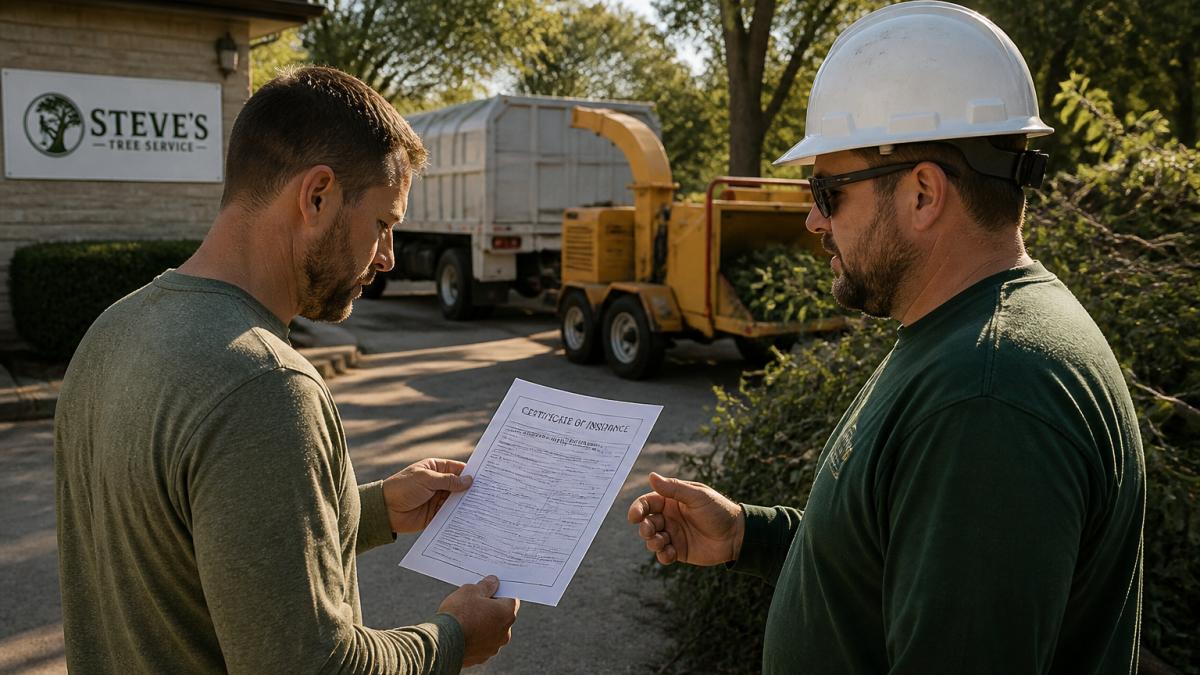
Ask for three documents: a certificate of liability insurance, proof of workers’ compensation coverage, and any relevant certifications.
Liability insurance covers damage to your home or property. Workers’ compensation covers injuries to the crew. Both matter, and they protect you, not just the company.
How to Verify Insurance and Credentials
Don’t just accept a photo of a certificate. Call the insurer listed on it and confirm the policy is active.
Here’s a step-by-step way to verify coverage without guesswork:
- Request the certificate of liability insurance. This one-page document lists the insurer, policy number, effective dates, and coverage limits. It should name the tree company as the insured.
- Call the insurer’s verification line. The phone number is usually printed on the certificate. Ask: “Is this policy active today, and does it cover tree removal work at residential properties?”
- Confirm workers’ compensation. In most states, employers must carry workers’ comp. Ask for the policy number and insurer, then verify the same way. If a crew member is injured on your property and the company lacks coverage, you could be exposed to a claim.
- Check for gaps in coverage. Ask whether the policy excludes certain work, like crane-assisted removal or work near power lines. A policy that excludes the exact work you need is not protection.
- Look up arborist credentials. A certified arborist has passed a recognized exam and stays current on tree care standards. The International Society of Arboriculture maintains a searchable directory of certified arborists. You can look up a name in minutes.
A certificate that lists “additional insured” with your name is stronger than one that doesn’t. If the company can’t add you as an additional insured for the job, ask why.
Licensing varies by state and locality. Some states require tree services to hold a specific license; others regulate them under general contractor rules. Check your state’s contractor licensing board or your local government website to see what applies. If a license is required and the company can’t produce a number, walk away.
Credentials go beyond insurance. Ask what training the crew holds, for example, ISA Certified Arborist status, Tree Care Industry Association (TCIA) accreditation, or American Society of Consulting Arborists (ASCA) membership.
A final check: ask for the name of the person who will actually be on site and whether that person holds the credentials.
Verification is a five-minute phone call. If a company resists or delays, that’s your answer, move on.
Read Reviews and Ask for References From Local Homeowners
Reviews tell you how a company behaves when things get hard. Anyone can post a five-star rating.
Read the two- and three-star reviews first. Look for complaints about cleanup, surprise charges, or crews that didn’t show.
Then ask for references from homeowners near you.
Customer reviews and references together give you a fuller picture than either one alone. One is public opinion.
Ask references three things: Did the crew show up when promised? Was the final bill what was quoted? Was the yard clean when they left?
Get a Free Tree Service Estimate →
Questions to Ask a Tree Service Before You Book
The right questions separate a professional crew from a crew with a truck. Ask them before anyone sets foot on your property.
- Are you insured, and can I see the certificate?
- Will you put the full scope in writing?
- Is stump grinding included or separate?
Questions to ask a tree service should focus on scope, liability, and timing. Vague answers to any of these are a warning.
One more: ask who will actually be on site. Some companies quote the job and send a different crew.
Use a Tree Service Estimate Checklist to Compare Written Quotes
A written estimate is the only way to compare providers fairly. Verbal quotes shift. Paper doesn’t. But not all written estimates are created equal, some are one line, others are detailed enough to protect you. The goal is to compare apples to apples, and that means knowing what to look for beyond the bottom line.
Use this tree service estimate checklist when you review each bid:
- Company name, address, and contact info
- Date of the estimate and how long it’s valid
- Itemized scope: removal, trimming, stump grinding, cleanup
What a Written Estimate Should Include
A complete estimate names the work, the cleanup, and the timeline. It should also say what is not included. Watch for one-line estimates that just say “remove tree.” They leave room for surprise charges later.
Here’s how to compare three bids side by side:
| What to Compare | Why It Matters | Red Flag |
|---|---|---|
| Scope detail | Shows exactly what’s covered | One-line description |
| Stump grinding | Often a separate cost | Left unmentioned |
| Cleanup and hauling | Affects your weekend | “We’ll leave the chips” |
| Equipment listed | Crane work vs. climbing affects risk and timeline | No equipment mentioned |
| Insurance proof | Protects your property | “We’re covered” with no paper |
| Timeline | Sets expectations | No dates at all |
| Exclusions | Reveals hidden extras | No exclusions listed |
The lowest bid is not automatically the best. A cheap quote that skips cleanup or insurance costs more in the end.
How to Compare Scope, Cleanup, and Disposal
When you line up three estimates, read the scope line by line. Does one company include stump grinding while another lists it as an add-on? Does one haul away all debris while another leaves the chips for you to deal with? These differences matter more than the total.
Cleanup should specify: removal of all branches and logs, raking of the work area, and disposal of chips. If the estimate says “cleanup included,” ask what that means in practice, some companies leave the wood for you to split or haul.
Disposal is often a separate line item. Ask where the debris goes and whether the cost is included. A company that charges extra for disposal may still be competitive, but you need to know before you sign.
Equipment and Timeline: What They Reveal
The equipment listed tells you how the job will be done. A bucket truck or crane is safer for large or hazardous trees; climbing with ropes is common for smaller jobs.
Timeline should include a start date and an estimated completion. Ask whether the crew will work consecutive days or split the job. A vague timeline (“sometime next month”) makes it hard to plan and can signal a company that overbooks.
Exclusions: The Fine Print That Matters
Every estimate should list what is not included. Common exclusions: stump grinding, debris hauling, permit fees, utility coordination, and repair of damaged landscaping. If an estimate has no exclusions, ask directly: “What’s not covered?” A reputable company will tell you.
Create a simple spreadsheet with one column per bid and one row per checklist item. Fill it in as you read each estimate. The gaps become obvious fast.
Comparing written estimates is not about finding the cheapest number, it’s about finding the clearest scope. A detailed estimate from a slightly higher bid often saves money by preventing surprise charges and ensuring the job is done right.
Tree Service Red Flags That Should Stop the Conversation
Some warnings are loud enough to end the conversation on the spot. Learn them before you sign anything.
Tree service red flags include:
- Door-to-door sales after a storm
- Pressure to sign today for a “special rate”
- No written estimate or contract
Storm chasers are the biggest risk. They appear after every major storm, take deposits, and disappear.
A reputable company will give you time to think. If someone won’t, that’s your answer.
Request Your Free Estimate From a Local Crew You Can Verify
You’ve done the work. Now it’s time to book with a crew you can actually check out.
Weatherford homeowners trust Steve’s Tree Service LLC for safe tree removal, professional tree trimming, and dependable cleanup.
We’re Christian-owned, fully committed to honest work, and we offer free estimates. Our customers notice the difference.
When you’re ready, you can request tree removal service or contact our team to schedule your free estimate.
Frequently Asked Questions
How do I know if a tree service is reputable?
Look for a local business with a verifiable track record: a real business name and address, recent customer reviews you can read in full, and references from nearby homeowners who will talk about the work. Ask how long the company has operated in your area and whether the same crew that gives the estimate will do the job. A reputable provider will answer these questions without hesitation and invite you to check their credentials.
What credentials should a tree service have?
At minimum, ask for proof of liability insurance and workers’ compensation coverage, plus any state or local licensing your area requires. Ask whether anyone on the crew holds arborist certification or belongs to a professional tree care association. Certified arborist credentials show someone has passed an exam on tree health and safe pruning. Experience matters too: a company that has handled hazardous trees and storm damage for years will describe its process clearly.
How can I verify that a tree service is insured?
Ask for a certificate of insurance and check that the policy is current and names the correct business. Call the insurance agent listed on the certificate to confirm the policy is active, and ask whether it covers liability and workers’ compensation. If a crew member is injured on your property and the company has no workers’ compensation coverage, you could face a claim. Never accept a verbal yes in place of paperwork.
What are warning signs of an unreliable tree service?
Watch for door-to-door pitches after a storm, pressure to decide on the spot, cash-only demands, and estimates given without anyone looking closely at the tree. Be cautious if a provider cannot show insurance, refuses to put the scope in writing, or quotes a number far below every other bid. A written estimate that lists what is included, who handles cleanup, and what happens if something is damaged protects you far more than a friendly handshake.
Finding reliable tree services comes down to doing the checks most homeowners skip. Verify the insurance, read the reviews, compare the written quotes, and trust the red flags when you see them.
Steve’s Tree Service LLC makes that easy. You get free estimates, a written scope, thorough cleanup, and a crew that treats your property like their own. Get started with Steve’s Tree Service LLC and book a free estimate today.
