
Table of Contents
- Professional Tree Care in Weatherford TX: What Homeowners Need
- How to Find a Good Tree Service in Parker County
- Questions to Ask a Tree Service Before You Hire
- Tree Service Estimates: How to Compare Them Fairly
- Tree Removal Cost in Parker County: What Affects the Price
- Season-by-Season Tree Care Calendar for Weatherford
- Safe Homeowner Maintenance vs. Work That Needs a Pro
- Conclusion: Choosing Professional Tree Care in Weatherford
- Frequently Asked Questions
Last Updated: October 8, 2026
Professional Tree Care in Weatherford TX: What Homeowners Need
Professional tree care Weatherford TX homeowners can rely on covers trimming, removal, stump grinding, and health assessments, and it all starts with tree care Weatherford residents can trust.
The stakes are higher than most people realize. The International Society of Arboriculture’s tree care guidance notes that proper pruning and timely removal prevent the majority of storm-related tree failures.
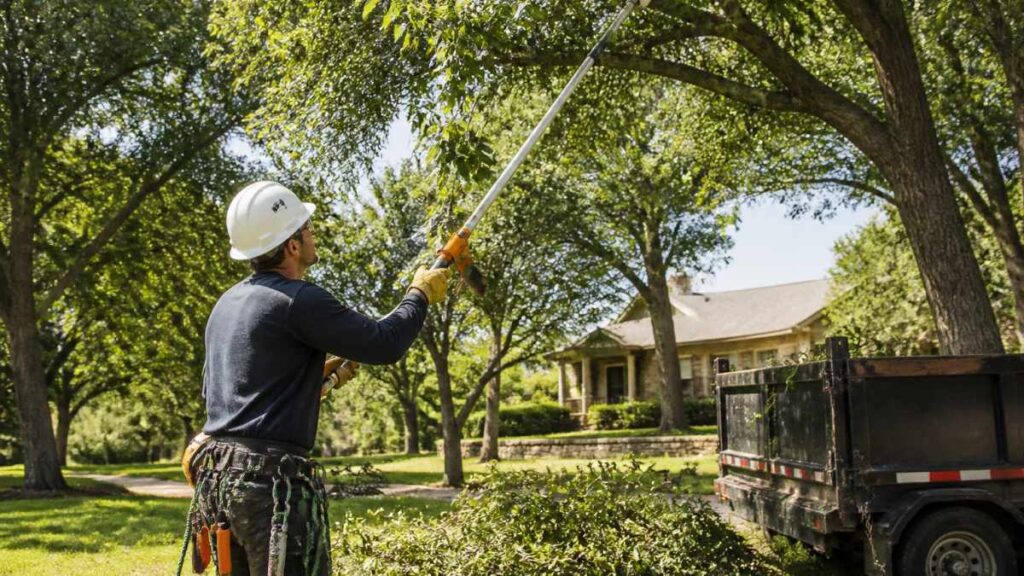
Tree work is one of the most dangerous trades in the country. If a job requires climbing, a chainsaw above shoulder height, or working near power lines, it belongs to a licensed professional, not a weekend project.
How to Find a Good Tree Service in Parker County
Finding a good tree service starts with verifying credentials, reading real reviews, and asking direct questions before anyone touches your trees. The best providers welcome those questions. The ones who dodge them are the ones to avoid.
Checking Credentials and Insurance
Ask every provider for proof of liability insurance and workers’ compensation coverage. If a crew member is injured on your property and the company carries no workers’ comp, the claim can land on your homeowner’s policy.
A certified arborist credential from the International Society of Arboriculture credential program signals formal training in tree biology and safe pruning practice. Not every job needs a certified arborist on site, but complex removals and disease diagnosis do.
Reading Reviews and Local Reputation
Look for reviews that mention cleanup, punctuality, and final price versus the quote. Steve’s Tree Service LLC carries 73+ five-star Google reviews: Betsy S. wrote that Steve “does great work, professional and takes care of all the mess,” and James F. noted the crew finished “as quickly as quoted, including cleanup.” Cleanup and honoring the quote separate a real operation from a fly-by-night crew.
Questions to Ask a Tree Service Before You Hire
Ask these questions before you sign anything: Are you insured? Who will be on site? Is stump grinding included? What happens to the debris? How long will the job take?
A common mistake is assuming stump grinding comes with removal. It usually does not. Ask whether the quote covers grinding, hauling the chips, and filling the hole, in writing.
Here is the short list we recommend every homeowner run through:
- Can I see your certificate of insurance?
- Is the person quoting the job the same person doing the work?
- Does the price include complete debris removal and hauling?
Ask for the estimate in writing with the scope spelled out line by line. A verbal quote that says “we’ll take care of it” is how surprise charges start. A written scope protects both sides.
Tree Service Estimates: How to Compare Them Fairly
Comparing tree service estimates fairly means comparing scope, not just the bottom-line number. A lower quote often excludes stump grinding, debris hauling, or ground protection, and those add-ons close the gap fast. Line up two or three estimates on the same criteria:
| What to Compare | Why It Matters | Red Flag |
|---|---|---|
| Scope of work | Defines exactly what gets cut and removed | Vague one-line descriptions |
| Stump grinding | Often billed separately | “We’ll discuss after” |
| Debris hauling | Disposal fees vary | “You can keep the wood” |
| Insurance proof | Protects your property and policy | Refuses to show it |
| Timeline | Sets expectations | No date commitment |
Steve’s Tree Service LLC offers free estimates, and we put the scope in writing so there are no surprises after the job.
Tree Removal Cost in Parker County: What Affects the Price
Tree removal cost in Parker County depends on tree size, location, access, and how much debris you want hauled away. There is no flat rate because no two trees present the same challenge. We quote each job individually; here is what moves the number.
Tree Size, Location, and Access Conditions
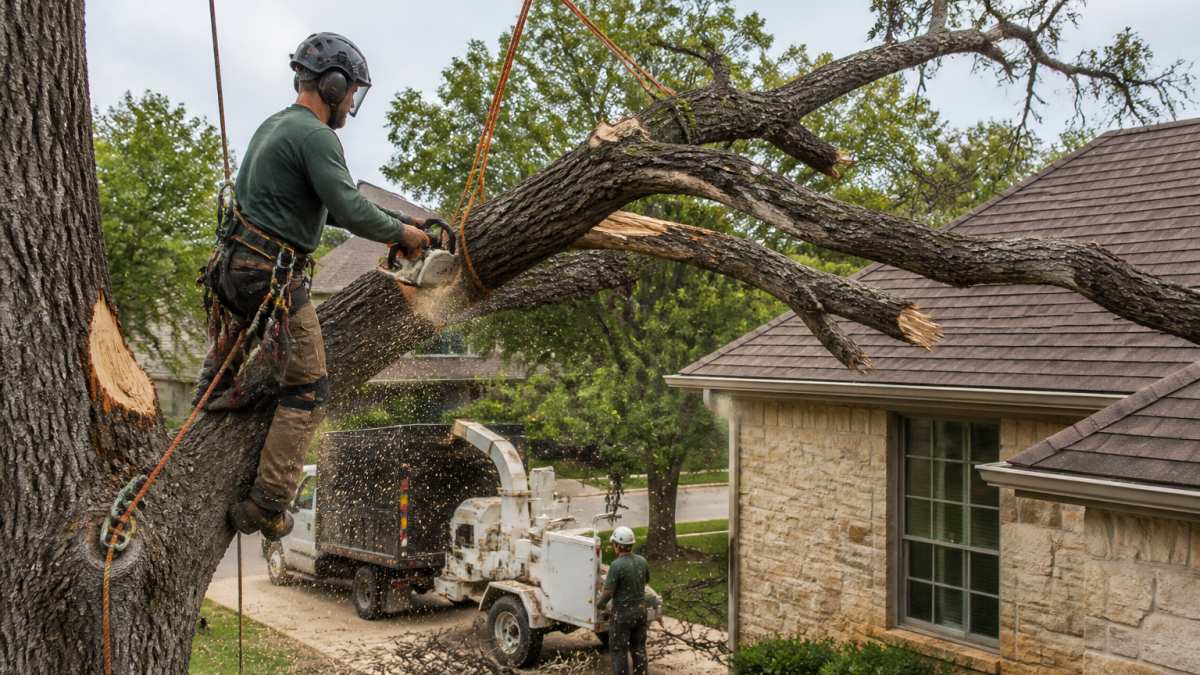
The bigger the tree and the tighter the access, the more equipment and time the job requires. A tree in an open field comes down fast; one wedged between a fence and a roofline takes rigging, climbing, and careful section-by-section removal.
- Tree size and height: Larger canopies mean more cuts and more debris.
- Proximity to structures: Trees near homes, garages, or power lines require controlled rigging.
- Access conditions: A narrow gate or soft lawn limits where a truck and chipper can park.
Never let anyone climb a tree near power lines without confirming they coordinate with the utility. Contact with an energized line is fatal, and it is not a job for a general handyman.
Season-by-Season Tree Care Calendar for Weatherford
Most tree care pages list services; very few tell you when to do them. In this part of North Texas, the timing window matters more than the task itself, because our climate swings from hard freezes to 100-degree summers within the same year. Here is the calendar we hand to Parker County homeowners.
| Window | Tree Stage | What to Do | What to Avoid |
|---|---|---|---|
| Late December – February | Dormancy | Structural pruning on oaks, pecans, and elms; deadwood removal; hazard inspections while the canopy is bare | Pruning oaks after February, see the oak wilt note below |
| March – April | Bud break and flush | Fertilization for established shade trees; plant new bare-root or container trees; inspect for aphids and scale on new growth | Heavy pruning, you’ll remove the energy the tree just spent producing |
| May – June | Active growth | Deep watering during dry spells; watch for bagworms on junipers and webworms on pecans; raise mower decks around surface roots | Topping or “shaping” cuts that remove more than about a quarter of the live canopy |
| July – August | Heat stress | Water deeply and infrequently (a slow soak beats a daily sprinkle); mulch 2-3 inches out to the drip line, kept off the trunk; delay major pruning | Fertilizing, pushing new growth in peak heat stresses the tree |
| September – October | Hardening off | Remove deadwood before winter winds; final structural pruning on species that aren’t oak; plant fall trees | Pruning oaks, the sap-feeding beetles that spread oak wilt are most active in warm months |
| November | Dormancy onset | Leaf cleanup; drain and store hoses; schedule any removal work for the dormant window | Ignoring a leaning or cracked tree just because it survived the summer |
Why Late Winter Is the Pruning Window Here
For most shade trees, the dormant window from late December through February is ideal: structure is visible without leaves, wounds close faster as growth resumes, and there is no active pest pressure. The major exception is oak wilt. Sap-feeding beetles that vector the disease are most active from roughly February through June, so oak pruning is best confined to the coldest part of winter.
What to Watch For by Species
- Live oaks and red oaks: Oak wilt is the headline risk. Watch for leaves that brown from the margins inward and drop mid-season, often on one side of the canopy first.
- Pecans: Webworms and pecan scab show up in warm, humid stretches. Fall webworm tents are cosmetic; heavy defoliation year after year is not.
- Junipers and cedars: Bagworms build cone-shaped cases that look like part of the foliage until the tree browns out.
Photograph your trees from the same two or three angles each season. Comparing photos year over year is the easiest way to spot a canopy that is thinning, a lean that is worsening, or a wound that is not closing.
Storm Season Prep
Severe weather here clusters in spring and again in late fall. Before each window, walk the property and look for dead limbs still attached, cracks at the trunk or branch unions, and trees that have begun to lean since the last storm, those are the failures that end up on a roof. After a storm, inspect from the ground only: never go up a ladder with a chainsaw, and treat any limb touching a power line as energized until the utility says otherwise.
Safe Homeowner Maintenance vs. Work That Needs a Pro
Most tree care pages either tell you to call a pro for everything or hand you a chainsaw and wish you luck. The honest answer is that a real line exists, defined by three things: whether your feet leave the ground, whether the tree could hit something that matters, and whether the tool you are holding can kill you in a single mistake.
Here is how we draw it.
Jobs Homeowners Can Usually Handle Safely
- Raking and bagging leaves and small twigs, no cutting involved.
- Watering young or newly planted trees, a slow soak at the root zone, once a week in dry weather, beats a daily sprinkle.
- Mulching, 2 to 3 inches deep, pulled back a few inches from the trunk so the bark can breathe.
Jobs That Belong to a Professional
- Anything above your head with a chainsaw. Chainsaw kickback is the leading cause of serious chainsaw injuries, and it happens fastest when you are reaching, off-balance, or working overhead.
- Any climbing, roping, or rigging. This is a separate skill set from cutting. A tree that looks straightforward from the ground often has a lean, a hollow, or a weak union that changes the whole plan.
- Any tree within striking distance of a house, garage, fence, vehicle, or power line. Even a small tree can total a roof.
The Failure Modes Most People Don’t See Coming
The danger in tree work is not just the fall. It is the limb that barber-chairs, where the cut closes on the saw and the tree splits unpredictably. It is the dead branch overhead, called a widowmaker, that drops when saw vibration reaches it. It is the tree that looks solid from the ground but has a hollow core or a root plate already lifting.
If a tree is leaning toward a structure, has a visible crack at the trunk, or has mushrooms growing at the base, do not park under it, do not work under it, and do not try to “take a little off the top” to relieve the weight. Call a professional and keep people and pets clear until it is assessed.
A Simple Rule of Thumb
If you have to ask whether a job is safe to do yourself, it probably is not. A professional removal almost always costs less than an emergency room visit, a damaged roof, or a liability claim from an injured helper. When in doubt, get an assessment, most reputable companies will tell you honestly whether a job is a same-day fix or a full removal.
Conclusion: Choosing Professional Tree Care in Weatherford
Choosing the right crew comes down to proof: insurance, written scope, and a verifiable track record. When a dead tree is leaning toward your home or a storm has left branches across the yard, you want a team that shows up fast and cleans up completely.
Steve’s Tree Service LLC has served Weatherford and Parker County for over 12 years as a Christian-owned and operated business. From safe tree removal and expert trimming to storm cleanup and stump grinding, we treat your home with respect from the first call to the final sweep.
Get a quote from Steve’s Tree Service LLC and protect your property with tree care done right.
Frequently Asked Questions
How much does tree removal cost in Parker County?
Tree removal cost in Parker County depends on tree size, location, and access conditions. A small tree far from structures costs less than a large, hazardous tree near power lines or a home. Stump grinding and debris hauling are often separate line items. Steve’s Tree Service LLC provides free estimates. Visit their website for current pricing or request a quote.
What should I ask a tree service before hiring them?
Ask about insurance, years of experience, and whether they handle cleanup and debris hauling. Confirm if stump grinding is included or extra. Request a written estimate that lists every line item. Ask for local references and check reviews. A trustworthy provider will answer these questions without hesitation and give you a free estimate in writing.
How do I compare tree service estimates fairly?
Compare estimates line by line: removal, trimming, stump grinding, debris hauling, and cleanup. A low bid that excludes hauling or stump work is not the same job. Check whether the estimate includes ground protection and safe work practices. Look for a provider who explains what affects the price, such as tree size and access conditions, rather than giving a vague lump sum.
When should I hire a certified arborist instead of a tree removal service?
Hire a certified arborist for tree health assessments, disease diagnosis, and preservation planning. If a tree is dead, leaning toward your house, or close to power lines, you need a professional tree care company with the equipment and insurance to remove it safely. An arborist consultation can determine whether a tree can be saved or must come down.