
Table of Contents
- What the Cost of Tree Removal in Weatherford Actually Includes
- Tree Removal Cost Factors That Move the Number Most
- How to Get a Tree Removal Cost Estimate You Can Trust
- Stump Grinding Cost and Other Add-Ons
- Emergency Tree Removal Cost After a Storm
- Permits, Property Lines, and Local Rules
- How to Compare Tree Service Quotes and Avoid Surprise Charges
- Frequently Asked Questions
Last Updated: October 12, 2026
What the Cost of Tree Removal in Weatherford Actually Includes
The cost of tree removal in Weatherford is not a single line item. It is a bundle of labor, equipment, disposal, and risk that changes with every tree.
That frustrates homeowners, and we understand why. The International Society of Arboriculture guidance on selecting a qualified tree care provider is clear that tree work should be priced after an on-site assessment, because the variables that drive cost are not visible from a photo or a phone description.
- Labor and crew size. A straightforward removal might take two people half a day; a hazardous tree near a structure can occupy four people for a full day or more.
- Equipment. Chainsaws, ropes, rigging, chippers, and sometimes a bucket truck or crane.
- Disposal. Hauling limbs and trunk wood off your property, plus tipping fees.
Why No Two Yards Get the Same Quote
Two trees of identical height can produce wildly different quotes. A clear lawn with driveway access is a different job than a fenced backyard with a shed, a pool, and a power line overhead. The tree matters, but the space around it often matters more.
The quote you receive is really a quote for access and risk, not just for the tree. When you compare estimates, compare what each one says about access, rigging, and cleanup, because that is where the real differences hide.
Tree Removal Cost Factors That Move the Number Most
Five factors move a tree removal quote more than anything else: size and height, condition, location and access, proximity to structures or lines, and add-on services.
Tree Size and Height Categories
Height is the first thing a crew estimates, and it drives everything from ladder work to whether a crane is needed.
| Size Category | Typical Height | What Drives the Work | Relative Cost |
|---|---|---|---|
| Small tree | Up to 25 feet | Hand tools, minimal rigging, easy disposal | Lowest |
| Medium tree | 25 to 50 feet | Sectional felling, some rigging, chipper needed | Moderate |
| Large tree | 50 to 80 feet | Careful rigging, possible bucket truck | High |
| Very large tree | Over 80 feet | Crane or advanced rigging, traffic or line concerns | Highest |
The jump from small to medium is usually modest. The jump from medium to large is where quotes climb sharply, because equipment and time change category.
Condition, Location, and Site Access
A dead tree is not automatically more expensive than a healthy one, but a hazardous tree almost always is. Dead wood is unpredictable, limbs can drop without warning, and the crew must work more slowly. A tree leaning toward your house or tangled in power lines raises the risk and the price.
Access is the factor homeowners underestimate most. Ask yourself:
- Can a truck and chipper reach the tree, or will everything be carried by hand?
- Is there a fence, pool, shed, or septic system in the drop zone?
- Are power lines within falling distance?
Each complication adds labor hours, which is why two neighbors on the same street can receive different quotes.
How to Get a Tree Removal Cost Estimate You Can Trust
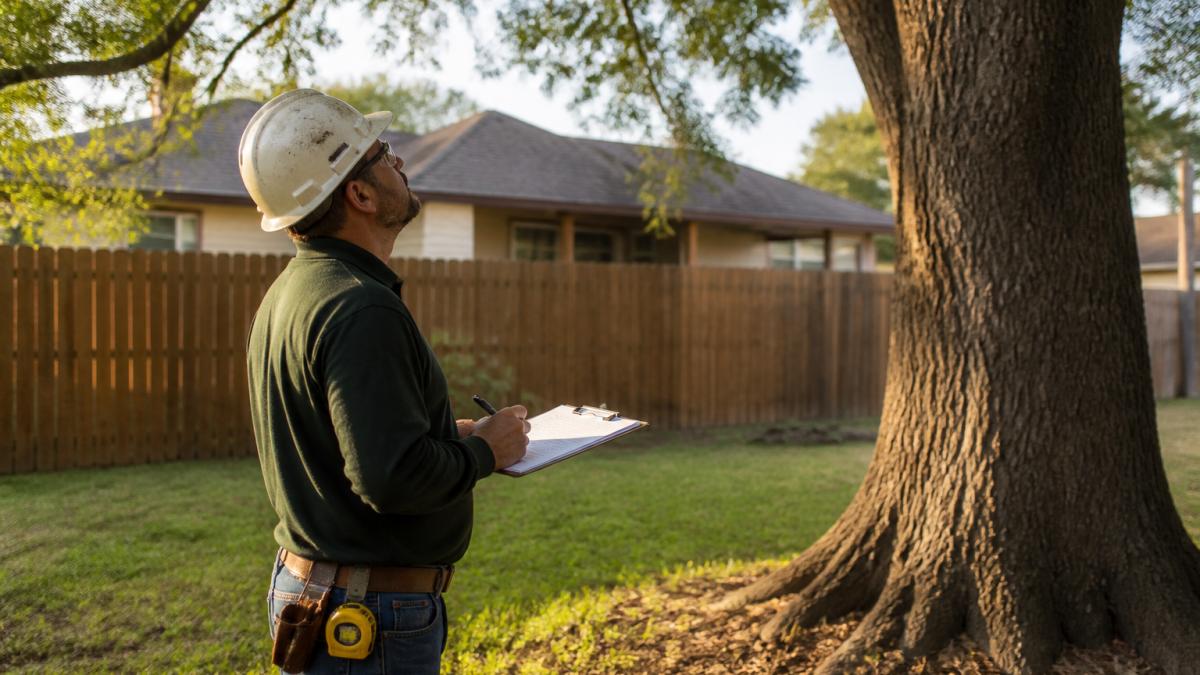
A trustworthy tree removal cost estimate comes from an on-site visit, not a phone call. Any provider willing to quote a hazardous removal without seeing it is either guessing or planning to revise the number on arrival. When we walk a property, we look at the tree, the ground, the structures, and the lines, ask what you want done with the wood and stump, and only then put a number on paper.
A legitimate estimate should include:
- A written scope: which trees, what work, and what is removed
- Whether stump grinding is included or billed separately
- Whether debris hauling is included
If an estimate is a single number on a text message with no scope, treat it as a placeholder, not a price.
The most common surprise charge comes from stump grinding and debris hauling being left out of the original quote. Confirm in writing whether the stump is ground, whether the grindings are removed, and whether all limbs leave your property. If it is not written down, assume it is not included.
Stump Grinding Cost and Other Add-Ons
Stump grinding is the most common line item that turns a “removal quote” into a bigger final bill, because it is usually priced separately. The removal price covers getting the tree down and the trunk and limbs off your property; the stump is a second job with its own equipment and disposal cost.
What actually drives stump grinding cost:
- Stump diameter. Price tracks the widest part of the stump, not the average. A 30-inch stump is a different job than an 18-inch one, even if the trees looked similar above ground.
- Root flare and buttress roots. Wide, flared bases, common on mature oaks and pecans, take longer because the grinder sweeps a wider area and makes more passes.
- Grind depth. A standard grind goes roughly 4 to 6 inches below grade, enough to cover with topsoil and sod. A deeper grind, often requested for replanting or pouring concrete, costs more.
Removal quotes often list stump grinding as an optional add-on, and homeowners assume it is included until the crew leaves the stump behind. Ask directly and get the answer in writing.
Other Add-Ons That Change Your Total
- Debris hauling. Some providers chip brush and leave trunk wood; others remove everything. If you want the wood gone, confirm it. If you want firewood, say so before the crew arrives so they cut usable lengths.
- Grinding cleanup. Grinding leaves chips and a shallow hole. Keep the chips for mulch, spread them, or pay to have them hauled and the hole backfilled.
- Land clearing. Multiple trees on a lot are usually priced as one combined project because crew, equipment, and disposal are shared. Ask for a per-tree breakdown anyway.
If you plan to replant in the same spot, ask for a deeper grind and for the chips to be hauled rather than left. Leaving a mound of grindings where you intend to plant makes it harder to establish anything new in that soil.
Emergency Tree Removal Cost After a Storm
Emergency tree removal cost runs higher than scheduled work because storm calls happen at night, on weekends, and when crews are stretched thin. A tree blocking a driveway or resting on a roof cannot wait for a normal appointment.
What raises emergency pricing:
- After-hours or weekend timing
- A tree already on a structure, vehicle, or line
- Blocked access that requires clearing before equipment can reach the tree
If a tree is touching or near a power line, do not attempt anything yourself. Call the utility first, then call a tree service.
Permits, Property Lines, and Local Rules
Before anyone starts a saw, three questions decide whether your removal is routine or a paperwork problem: does the tree sit on your property, is it in a public right-of-way or utility easement, and does your city regulate it. Most routine residential removals on private property do not require a permit, but the exceptions cost homeowners money.
When a Permit Is Usually Required
A permit is most often triggered when the tree is not fully on private property or when the city has decided the tree itself is protected. Common triggers:
- Trees in the public right-of-way. The strip between sidewalk and curb is typically city-controlled, even though it looks like part of your yard. Removing a tree there without approval can bring fines and a replanting requirement.
- Protected or heritage trees. Some cities list protected species or designate individual trees by size or age. Removing one without a permit can carry a penalty that dwarfs the removal cost.
- Trees in certain zoning or overlay districts. Commercial corridors, historic districts, and new-development zones often have stricter rules than ordinary residential lots.
The practical move is to call your city’s planning or code enforcement office and describe the tree’s location in plain terms, front yard, back yard, behind the sidewalk, next to the alley. They can tell you in minutes whether a permit applies. If you hire a local provider, ask whether they pull permits as part of the job.
Property Lines and Boundary Trees
A tree on or near a property line is the most common source of disputes, and the rules are not intuitive. In general:
- A tree whose trunk sits entirely on your side is yours to manage, even if branches overhang the neighbor’s yard.
- A tree whose trunk straddles the line may be jointly owned, and removing it without the neighbor’s agreement can create a legal problem costing far more than the removal.
- You typically may trim branches that cross onto your property, but only up to the line and only in a way that does not harm the tree. Cutting beyond the line, or in a way that kills the tree, can expose you to liability.
If a tree straddles the line, confirm the boundary, a survey is the clean answer, and get the neighbor’s agreement in writing before scheduling work.
Utility Lines and Easements
If a tree is touching or near a power line, do not attempt anything yourself, and do not assume a tree service will handle the line side of the work.
For anything involving a public right-of-way, a utility easement, or a protected species, confirm the requirement with the relevant local office before work begins. A five-minute call is cheaper than a fine.
Permits, property lines, and utility easements are the three pre-job checks that prevent the most expensive surprises. Confirm the boundary, confirm whether the city regulates the tree, and confirm who owns the lines before you book a crew.
How to Compare Tree Service Quotes and Avoid Surprise Charges
Comparing tree service quotes is not about finding the lowest number.
Use this checklist when you review each estimate:
- Is the scope written out tree by tree?
- Is stump grinding included, and to what depth?
- Is all debris hauled away, or left on site?
A provider who cannot commit to a date in writing will push your job when a bigger one comes in.
Steve’s Tree Service LLC offers free estimates and puts the scope in writing, the only way to compare quotes fairly.
Homeowners in Parker County who want a written scope, a firm date, and a crew that hauls every branch away before it leaves the property.
Tree removal pricing is genuinely variable, and no honest provider can quote a hazardous tree over the phone.
Frequently Asked Questions
How much does it cost to remove a tree in Weatherford?
The cost of tree removal in Weatherford depends on tree size, height, condition, and site access. Small trees are generally the least expensive, while large or hazardous trees near structures cost more because they require specialized equipment and extra crew. Steve’s Tree Service LLC offers free estimates so you get a firm number before any work begins, with no surprise charges added later.
What factors affect the cost of tree removal?
Tree removal cost factors include trunk diameter, height, species, lean, and overall tree health. A dead or hazardous tree leaning toward a house or power lines takes longer and needs more rigging than a straight, healthy tree in an open yard. Site access matters too: a tree next to a fence, shed, or driveway limits where equipment can go and slows the job.
Does tree removal cost more for large or hazardous trees?
Yes. Large trees and hazardous trees require more crew, heavier rigging, and slower, more controlled cuts to protect your property. A dead tree with brittle limbs is riskier to climb than a healthy one, and trees close to power lines or rooflines need extra safety measures. That added time and equipment is why these jobs sit at the higher end of any price range.
Is stump grinding included in a tree removal estimate?
Stump grinding is usually a separate line item, so ask before you sign. Stump grinding cost depends on stump diameter, root flare, and how deep the grinder goes below grade. If you want the chips hauled away instead of left as fill, that is another charge. Confirm in writing what is included so you are not surprised later.
How can I compare tree removal quotes?
Ask every provider for the same written scope: what is removed, how high the stump is cut, whether debris and chips are hauled off, and whether the yard is raked clean. Compare the itemized totals, not just the bottom line. A low quote that excludes cleanup or stump grinding often ends up costing more than a complete one. Also confirm insurance and credentials before hiring.
Does homeowners insurance cover tree removal after a storm?
Coverage varies by policy and situation. Many policies pay to remove a tree that falls on a covered structure, like a house, garage, or fence, up to policy limits. Removal of a tree that fell in the open yard with no damage is often not covered. Check your policy or call your agent before assuming, and keep photos of the damage.