
Table of Contents
- Why Routine Tree Maintenance Protects Your Home and Wallet
- How Often to Trim Trees: A Simple Schedule That Works
- Signs a Tree Needs Pruning Before Damage Happens
- Tree Pruning Best Practices for Healthy Growth
- Care for Newly Transplanted Trees: The First Two Years
- What Routine Tree Maintenance Costs and What It Saves
- DIY vs. Hiring a Professional Arborist
- Conclusion: Small Habits, Healthier Trees
- Frequently Asked Questions
Last Updated: October 10, 2026
Why Routine Tree Maintenance Protects Your Home and Wallet
Routine tree maintenance means inspecting, trimming, and caring for trees on a regular schedule rather than waiting for a problem to appear.
A mature tree that never gets pruned grows dense and top-heavy: the canopy blocks sunlight, traps moisture, and gives disease a place to spread.
The Arbor Day Foundation’s tree care guidance makes the same point: most tree failures trace back to structural problems that a trained eye can spot years in advance.
Routine tree maintenance is cheaper than emergency removal. You pay a small amount on a schedule instead of a large amount after damage.
How Often to Trim Trees: A Simple Schedule That Works
Most shade trees need pruning every three to five years, while fast-growing varieties and fruit trees often need attention every one to two years. The right answer depends on species, age, and proximity to your house.
Here is a schedule we use as a starting point:
| Tree Type | Pruning Frequency | Best Season |
|---|---|---|
| Fast growers (maples, willows) | Every 1-2 years | Late winter |
| Slow growers (oaks, hickories) | Every 3-5 years | Dormant season |
| Fruit trees | Every year | Late winter |
| Flowering trees | Every 2-3 years | After bloom |
| Newly planted trees | Light shaping only | First 2 years |
Climate shifts the calendar: warm, mild-winter climates prune earlier in the dormant season, while colder zones wait until the coldest stretch has passed. Storm damage ignores the schedule and should be handled as soon as it is safe.
Signs a Tree Needs Pruning Before Damage Happens
A tree usually tells you it needs help long before a limb lands on your roof. Dead branches, crossing limbs, and mushrooms near the base are the three signals we see most often.
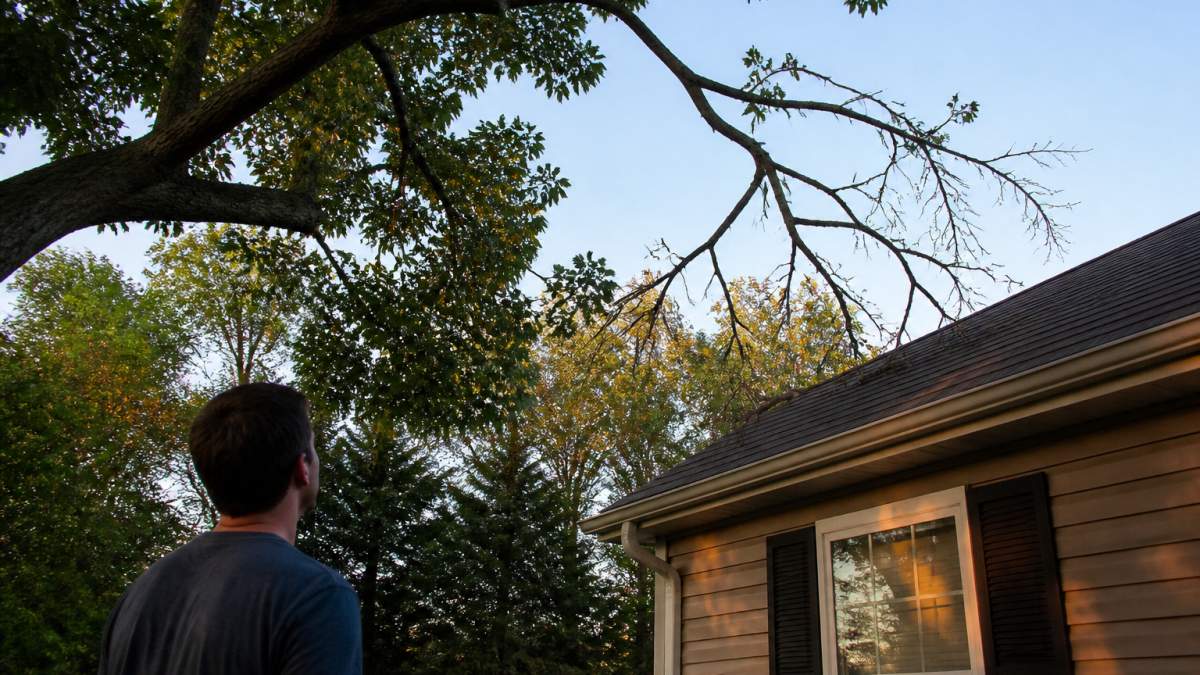
Walk your property twice a year and look for:
- Dead or leafless branches that stay bare through spring
- Limbs rubbing against each other or crossing at sharp angles
- Cracks, splits, or hollow spots in the trunk
If half the tree looks healthy and the other half is bare, call an arborist before storm season.
Ignoring a leaning dead tree near your house is the single most expensive mistake we see. Removal costs far less than repairing a roof, a car, or a fence after a limb falls.
Tree Pruning Best Practices for Healthy Growth
Good pruning comes down to three decisions: when you cut, where you cut, and how much you take. Get those right and a tree seals its own wounds. Get them wrong and you create a permanent entry point for decay.
When to cut
Late winter and early spring, while the tree is dormant and before buds break, is the standard window for most shade trees. Growth has stalled, structure is visible without leaves, and wounds get the full growing season to seal.
There are exceptions worth knowing:
- Flowering trees (dogwood, crabapple, cherry) should be pruned right after bloom, not in winter, so you do not cut off the flower buds that set the previous fall.
- Oaks are best pruned in late winter in most regions to reduce the risk of oak wilt, a fungal disease spread by sap-feeding beetles that are most active in spring and summer.
- Maples and birches bleed heavily if pruned in late winter or early spring. The bleeding is rarely fatal, but pruning in late spring or early summer after the sap has slowed avoids the mess.
Where to cut
Every pruning cut is a decision about the branch collar, the swollen ring of tissue where a branch meets its parent limb or trunk.
Three cut types cover almost every job:
- Branch removal cut, the standard cut, made just outside the branch collar, angled slightly away from the trunk. This is what you use for 90% of pruning.
- Reduction cut, made back to a side branch that is at least one-third the diameter of the limb you are removing. Used to shorten a branch without leaving a stub.
- Heading cut, cutting a branch back to a bud or arbitrary point. This stimulates bushy regrowth and weakens structure. Use sparingly, and never as a substitute for a proper removal cut.
For limbs larger than about two inches in diameter, use the three-cut method to prevent bark tearing: an undercut a few inches out from the collar, a top cut slightly further out that lets the limb drop, and a final clean cut at the collar once the weight is gone.
How much to take
Never remove more than 25% of the live canopy in one session. Trees rely on leaves to manufacture the sugars that fuel defense and root growth; strip too much and the tree pushes weak, poorly attached water-sprout regrowth that fails later.
A few hard rules that separate good pruning from damage:
- Never top a tree. Topping removes the leader and triggers a burst of weakly attached shoots. It shortens the tree’s life and creates the exact hazard the homeowner was trying to prevent.
- Sanitize tools between trees, especially when working on anything with visible disease. A 10% bleach solution or 70% isopropyl alcohol on the blades is enough.
- Remove dead, diseased, and damaged wood first. That is the priority order, and it is also the safest work because dead limbs are lighter and more predictable.
What homeowners can safely do
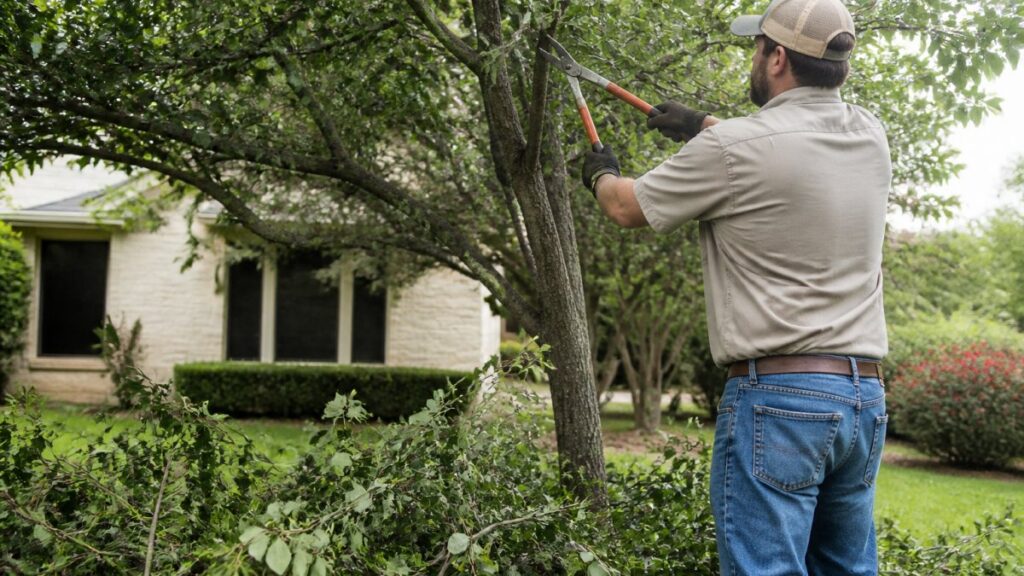
Safe for most homeowners: branches under two inches thick, reachable from the ground or a stable step stool, with both feet on solid footing and no overhead wires.
When in doubt, an arborist visit costs a fraction of an emergency room visit or a roof repair.
The USDA Forest Service guidance on pruning confirms that proper cuts let a tree seal wounds naturally, while poor cuts leave permanent openings for decay.
If you can reach the branch with both feet on the ground and the cut is under two inches, it is usually a homeowner job. If you need a ladder or a chainsaw, it is not.
Care for Newly Transplanted Trees: The First Two Years
Care for newly transplanted trees is mostly about water, mulch, and patience. The first two years decide whether the tree establishes a strong root system or struggles for a decade.
Water deeply once a week during dry spells, giving the root ball a slow soak rather than a light sprinkle.
Stake only if the tree is in a windy spot, and remove the stakes after one growing season. Prune only dead or broken branches during establishment.
What Routine Tree Maintenance Costs and What It Saves
Most articles stop at “maintenance saves money” without explaining what drives the bill. Here is the concrete version.
What drives the price of a routine visit
Tree service pricing is not a flat rate. It scales with variables a reputable company will walk through before quoting:
- Tree height and canopy spread. A 40-foot oak takes more time, rigging, and skill to prune safely than a 15-foot ornamental. Height is usually the biggest factor.
- Access. A tree in an open backyard is straightforward; one over a fence, between a house and garage, or next to a pool requires rigging, climbing, or a bucket truck, each adding labor.
- Proximity to structures and wires. Working near a roof, power drop, or driveway means slower, more careful work and sometimes a utility coordination call.
- Debris volume and hauling. Chipping and disposal are real costs; a light structural prune produces far less debris than a full deadwood removal.
Because these variables vary so much, any honest quote is property-specific. Be wary of anyone who gives a firm number over the phone without seeing the tree.
Preventive care vs. emergency removal
The financial case for routine maintenance is not that pruning is cheap. It is that emergency work is expensive in ways routine work is not.
An emergency call usually involves:
- After-hours or storm-response pricing
- A tree that is already failing, so the work is riskier and slower
- Possible damage to a roof, fence, vehicle, or siding that has to be repaired separately
- Insurance deductibles, claim paperwork, and possible premium impact
A scheduled pruning visit, by contrast, is planned work at planned pricing: the tree is healthy enough to prune safely, the crew works in daylight, and there is no property damage to coordinate. That gap is where the savings live.
The ongoing savings a maintained tree produces
Beyond avoided emergency costs, a well-maintained tree delivers measurable value every year:
- Summer cooling. A shaded roof and walls reduce air-conditioning load. The U.S. Forest Service research on urban trees has documented that properly placed shade trees lower residential energy use.
- Winter windbreak. A dense evergreen or a well-structured deciduous canopy can slow prevailing winter winds and reduce heating demand.
- Stormwater. A mature canopy intercepts rainfall and slows runoff, which reduces stress on gutters, grading, and drainage around the foundation.
- Curb appeal and resale. A well-shaped, healthy tree is one of the few landscape features that reliably shows up in appraised value. A hazard tree does the opposite, it becomes a disclosure item and a negotiation point.
How to think about the return
The simplest way to frame it: routine maintenance is a small, predictable annual or multi-year expense that protects a large, appreciating asset. A mature shade tree takes decades to replace, and no pruning budget recovers a tree lost to neglect.
For a number on your property, the right move is a walk-through.
For a current estimate, visit our pricing page or request a free quote, and we will walk the property with you.
Routine maintenance is planned work at planned pricing. Emergency removal is reactive work at premium pricing, often with property damage on top. The savings come from staying on the planned side of that line.
DIY vs. Hiring a Professional Arborist
Small branches under two inches thick, at ground level, with both feet on solid ground: fair game.
A professional arborist also brings something a homeowner cannot: an eye trained to spot structural problems before they become emergencies.
Here is how we would split the work:
| Task | DIY Safe? | When to Call a Pro |
|---|---|---|
| Small low branches | Yes | If above shoulder height |
| Deadwood removal | No | Always |
| Storm cleanup | No | Any limb near wires |
| Stump grinding | No | Always |
| Tree inspection | No | Every 2-3 years |
Steve’s Tree Service LLC handles the jobs that need experience, insurance, and the right equipment. Our customers tell us the difference shows up in the cleanup.
Conclusion: Small Habits, Healthier Trees
The biggest challenge with tree care is that the payoff arrives years later, which makes it easy to postpone.
Our team at Steve’s Tree Service LLC brings over 12 years of experience, free estimates, thorough cleanup, and honest pricing to every job in Weatherford and Parker County.
Get a quote from Steve’s Tree Service LLC and keep your trees healthy, your yard safe, and your home protected.
Frequently Asked Questions
What are the benefits of routine tree maintenance?
Routine tree maintenance keeps trees healthy and safe. It removes dead branches before they fall, improves airflow and sunlight penetration, and reduces pest and disease risk. Regular trimming also boosts curb appeal and can raise property value. For homeowners, the biggest benefit is hazard reduction: weak limbs near roofs, cars, or power lines get caught early instead of during a storm.
How often should trees be trimmed?
Most mature shade trees need trimming every 3 to 5 years. Fast-growing species like maples or willows may need attention every 2 to 3 years. Young trees benefit from light structural pruning every 2 to 3 years to shape strong branch angles. Dead, damaged, or diseased limbs should come off as soon as you spot them, regardless of schedule.
Can routine pruning help prevent tree disease?
Yes. Removing diseased branches limits the spread of infection to the rest of the canopy. Thinning overgrown branches improves air circulation, which dries leaves faster and makes fungal problems less likely. Clean cuts also heal better than torn limbs. Just avoid pruning oaks in spring in areas where oak wilt is present, and never remove more than 25% of the canopy in one season.
How do you care for newly transplanted trees?
Water deeply once or twice a week for the first two growing seasons, letting the soil dry slightly between waterings. Keep a 2 to 3 inch layer of mulch around the base, but pull it back from the trunk. Stake only if the tree is top-heavy or in a windy spot. Skip fertilizer the first year and prune only dead or broken branches until the tree establishes.